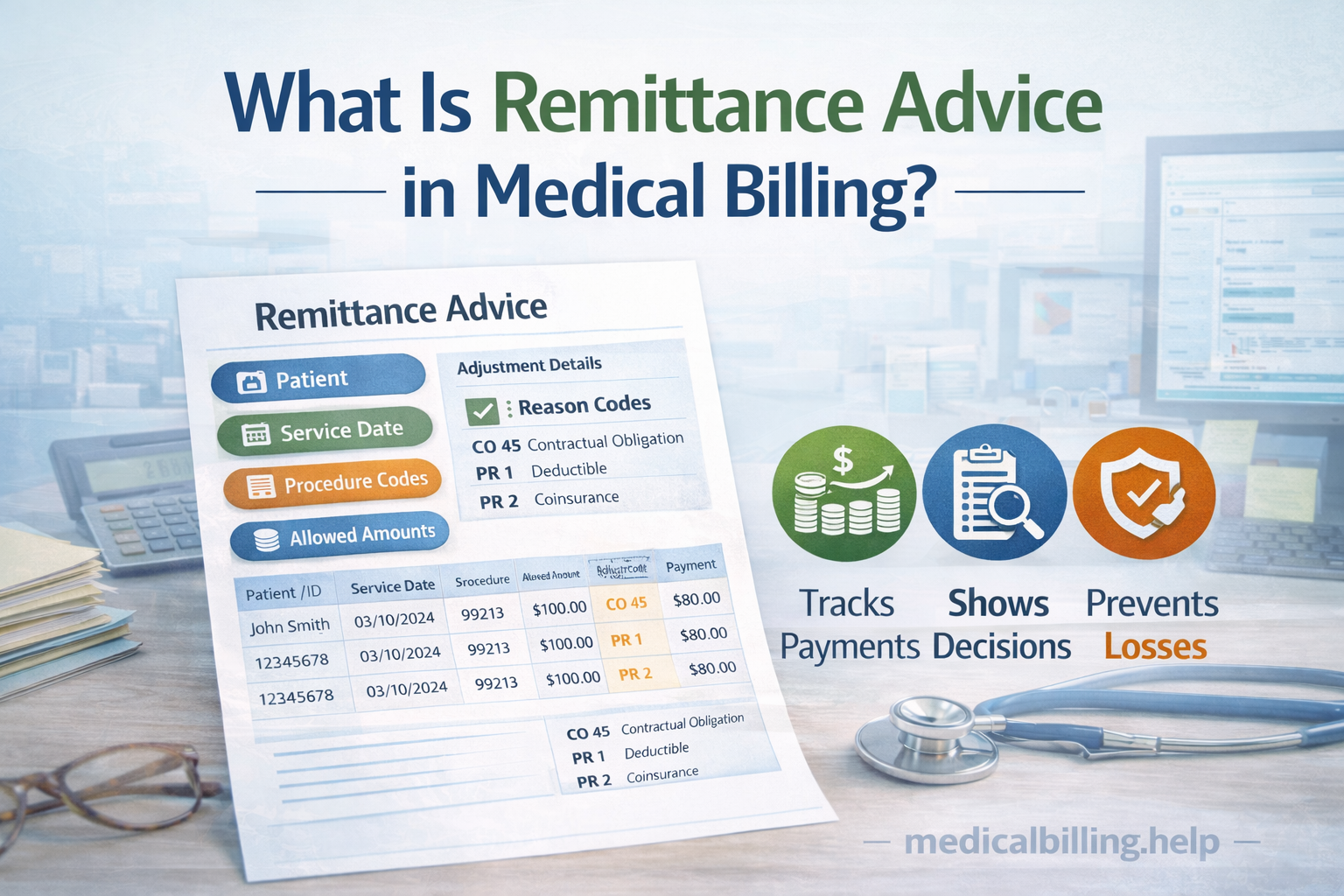
Remittance advice in medical billing is one of the most important documents a practice receives after a claim is processed. It tells the story of what happened to a claim after it reached the payer. It explains what was paid, what was adjusted, and what remains the responsibility of the patient or provider.
Many teams treat it as a routine report. They open it, scan the totals, and move on. But remittance advice is more than a summary. It is a direct line into how a payer thinks, calculates, and decides. When a practice understands it fully, it gains control over revenue, patterns, and future outcomes.
Understanding remittance advice in medical billing is not about paperwork. It is about visibility. And visibility protects income.
Table of Contents
ToggleWhat remittance advice means in simple terms
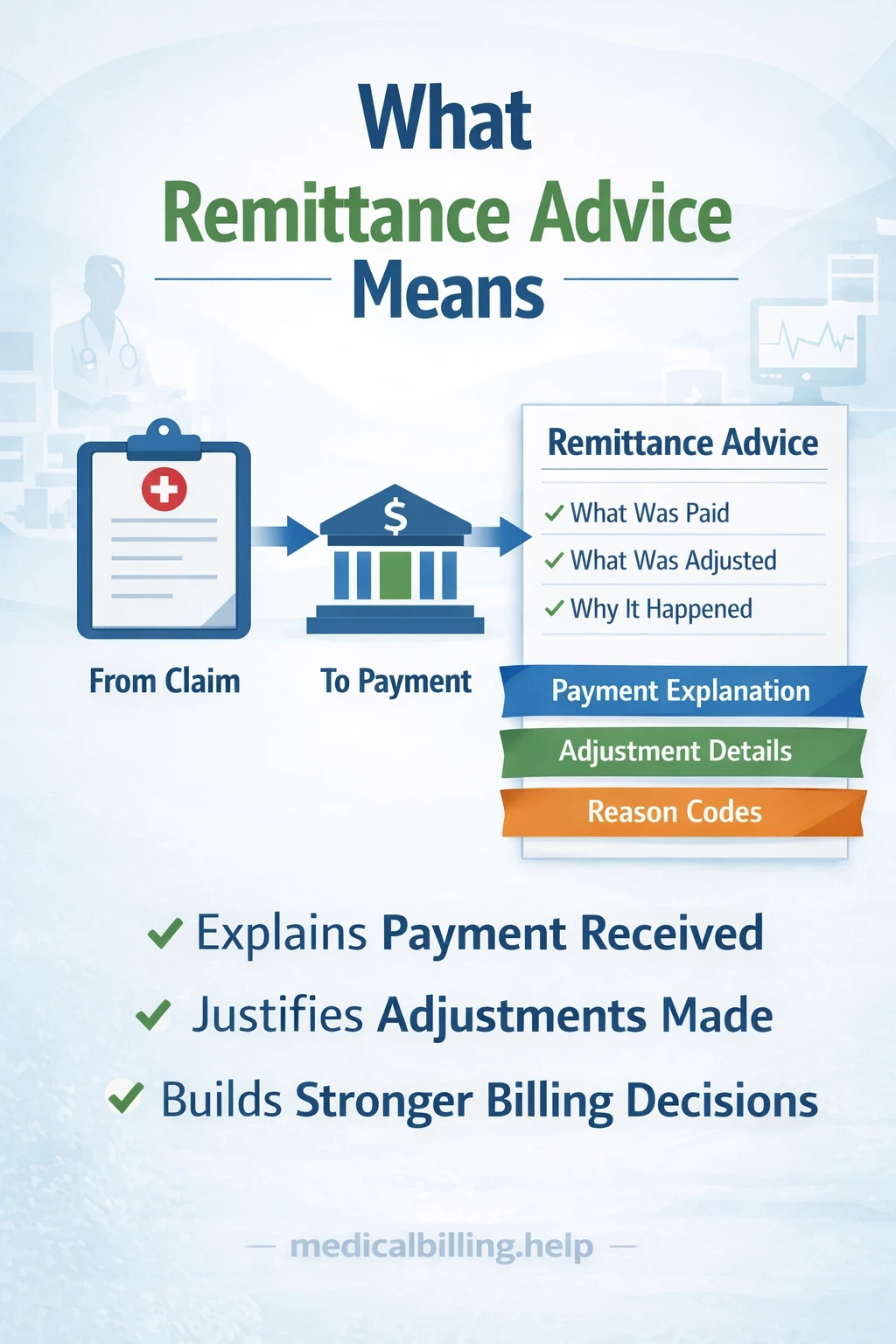
Remittance advice is a document that arrives after a payer reviews a submitted claim. It explains how the payer handled each service line. It shows what the payer approved, what the payer reduced, and why those decisions happened.
Think of it as a conversation from the payer back to the provider. The provider sends a claim. The payer responds with details. That response is the remittance advice.
This document acts as a medical billing payment report that closes the loop between submission and reimbursement. Without it, a practice would only see deposits without context. With it, every dollar has an explanation attached.
Remittance advice does not just confirm payment. It confirms logic. It shows rules, limits, and coverage decisions in action. That insight helps billing teams adjust their future strategy.
Why remittance advice matters for practice revenue
A practice earns revenue in the exam room. Billing protects that revenue afterward. Remittance advice in medical billing stands at the center of that protection.
Every line on the document reveals how accurately a claim matched payer expectations. When reductions appear often, the remittance advice highlights patterns. These patterns may signal coding gaps, documentation limits, or contract issues.
Ignoring this information allows small losses to repeat. Studying it allows correction.
Remittance advice also supports financial clarity. It connects bank deposits to claim level detail. It ensures that the money received matches the services delivered. This connection strengthens trust inside the practice and prevents silent revenue erosion.
Strong billing teams treat remittance advice as a learning tool. They use it to improve future submissions instead of only closing past accounts.
How remittance advice fits into the healthcare reimbursement process
The healthcare reimbursement process moves through clear stages. A provider delivers care. The provider submits a claim. The payer reviews that claim. Then the payer responds.
That response is remittance advice.
It marks the transition from review to payment. It finalizes the payer decision and records it in writing. This step transforms an open claim into a resolved financial event.
Because it sits at the end of the process, remittance advice carries weight. It represents the official position of the payer. Any follow up, appeal, or correction begins with this document.
Billing teams rely on it to guide next steps. When the document shows full payment, the account closes. When it shows partial payment, the team investigates. When it shows denial, the team prepares action.
Remittance advice does not end the story. It defines the next chapter.
What information appears on a remittance advice
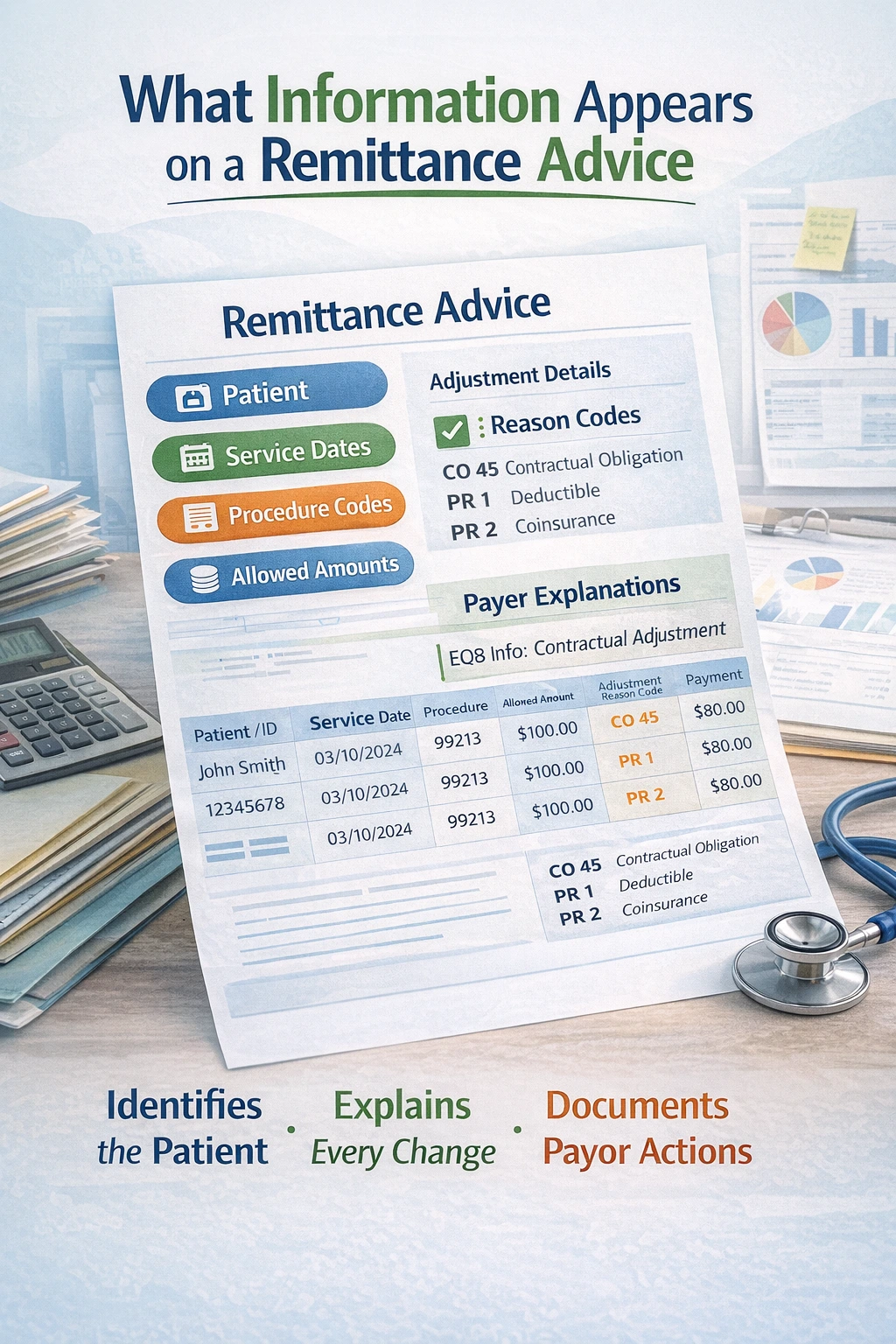
Remittance advice contains structured financial data. It includes patient identifiers, service dates, procedure codes, and allowed amounts. It also includes adjustment reasons and payer explanations.
These explanations form an insurance payment explanation that describes why a payer reduced or approved a charge. They may reference policy limits, contract rates, or coverage conditions.
Each line answers a simple question. Why did this number change from the billed amount to the paid amount?
This level of detail protects both the provider and the payer. It creates transparency. It ensures that financial decisions are traceable and reviewable.
Practices that read these details closely gain insight into payer behavior. Over time, this insight shapes smarter billing habits.
Electronic and paper remittance advice
Remittance advice appears in two main formats. Some payers send paper versions. Others send electronic files known as electronic remittance advice.
Electronic versions integrate directly into billing software. They speed up posting and reduce manual entry. They also allow faster analysis of claim payment details across large volumes.
Paper versions still serve practices that prefer manual workflows. They provide the same information but require human posting.
The format matters less than the discipline applied to review. Whether digital or printed, the value comes from attention.
Practices that invest time in reading remittance advice improve their financial accuracy. They transform data into decisions.
Common mistakes practices make with remittance advice
Many practices treat remittance advice as a simple confirmation instead of an investigative tool. They focus only on totals. They skip the explanations. They close accounts too quickly.
This habit creates blind spots.
When teams rush through posting, they miss recurring reductions. They fail to challenge questionable adjustments. They accept patterns that quietly reshape revenue.
Another mistake is separating billing from analysis. Posting without review reduces remittance advice to bookkeeping. True value appears when teams ask why numbers change.
Strong practices slow down just enough to understand the story behind each payment.
How remittance advice improves future claims
Every remittance advice document contains lessons. It reveals payer preferences and contract realities. When billing teams study these lessons, they submit stronger claims in the future.
They refine coding accuracy. They align documentation with payer expectations. They anticipate limits before submission.
This proactive mindset reduces denials and speeds payment cycles. It turns remittance advice into a training resource for the billing department.
Instead of reacting to losses, the practice prevents them.
The American Medical Association provides additional educational material on payment workflows which supports deeper understanding of payer communication.
The role of remittance advice in compliance and audits
Remittance advice also protects compliance. It creates a written record of financial decisions. During audits, it proves how payments were calculated and posted.
Accurate retention of remittance advice supports transparency. It shows that the practice follows consistent financial procedures. It documents every adjustment and approval.
This record keeping strengthens trust with payers and regulators. It also protects the practice during disputes.
When billing teams treat remittance advice seriously, they build a reliable financial archive.
Building a culture that respects remittance advice
Technology alone cannot protect revenue. Culture does.
Practices that respect remittance advice create routines around review. They train staff to read explanations. They encourage questions. They track patterns.
This culture transforms billing from a mechanical task into an analytical role. It empowers teams to defend earned income.
Over time, attention compounds. Small improvements add up. Revenue stabilizes. Confidence grows.
Remittance advice becomes a partner in decision making, not just a document to file away.
Conclusion
Remittance advice in medical billing is not optional paperwork. It is a map of how revenue moves through the system. It explains every financial decision after a claim leaves the practice.
When teams read it carefully, they protect value. When they ignore it, they surrender control.
The document does not demand complexity. It asks for attention. Practices that give it attention build stronger reimbursement habits, clearer records, and healthier cash flow.
In a field where margins depend on accuracy, remittance advice acts as a quiet guardian. It connects effort to payment and keeps the financial story honest.
FAQ
What is remittance advice in medical billing
Remittance advice in medical billing is a document sent by a payer that explains how a claim was processed. It shows payments, reductions, and reasons for financial decisions.
Is remittance advice the same as payment
No. Payment is the money transferred. Remittance advice is the explanation that describes how that payment was calculated.
Why should billing teams review remittance advice
Reviewing remittance advice helps teams detect patterns, correct future claims, and protect revenue from repeated reductions.
Can remittance advice be challenged
Yes. If a practice believes a payer made an error, the remittance advice serves as the starting point for appeals and follow up.
How long should practices keep remittance advice
Practices should retain remittance advice according to their compliance policies and payer requirements. Many keep records for several years to support audits and disputes.