Wound care reimbursement is an important topic for healthcare providers. Clinics, hospitals, and wound care specialists need to understand how Medicare processes payments. Correct billing helps practices avoid delays and reduce claim denials.
Medicare pays for wound treatment when the service is medically necessary. The provider must document the wound condition, treatment plan, and progress clearly. Strong documentation improves claim approval and supports accurate coding.
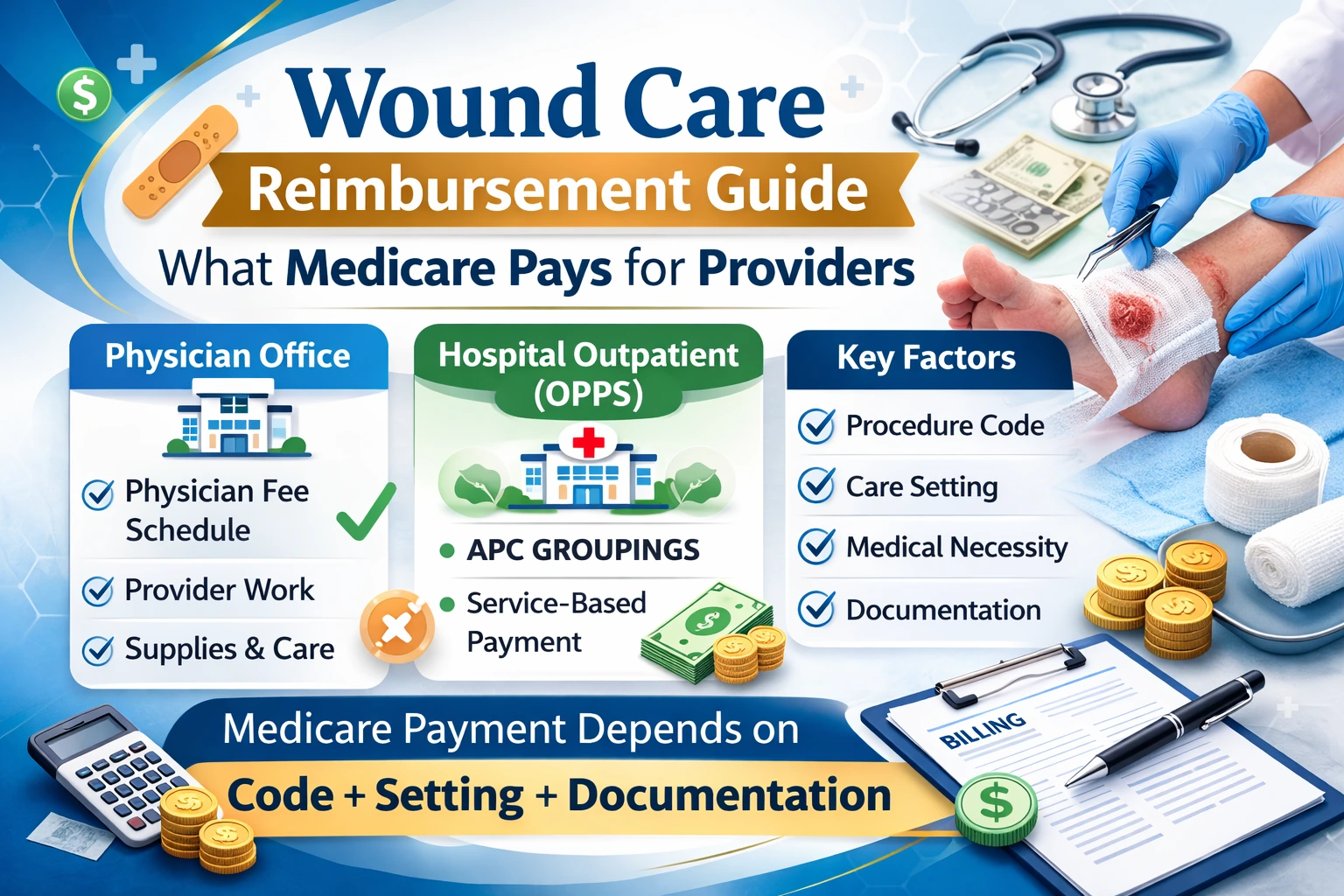
Many providers ask the same question. What will Medicare actually pay for wound treatment? The answer depends on several factors. The procedure code, place of service, and documentation all influence payment.
Medicare does not use a single payment rate for every wound service. Payment changes based on the type of care and the treatment location. For example, services performed in a physician office often follow the Physician Fee Schedule. Hospital outpatient departments follow a different system.
Providers should review payment tools regularly. CMS updates reimbursement rules each year. Checking these updates helps practices avoid outdated billing methods and improves wound care reimbursement results.
Table of Contents
ToggleHow Medicare Pays for Wound Care
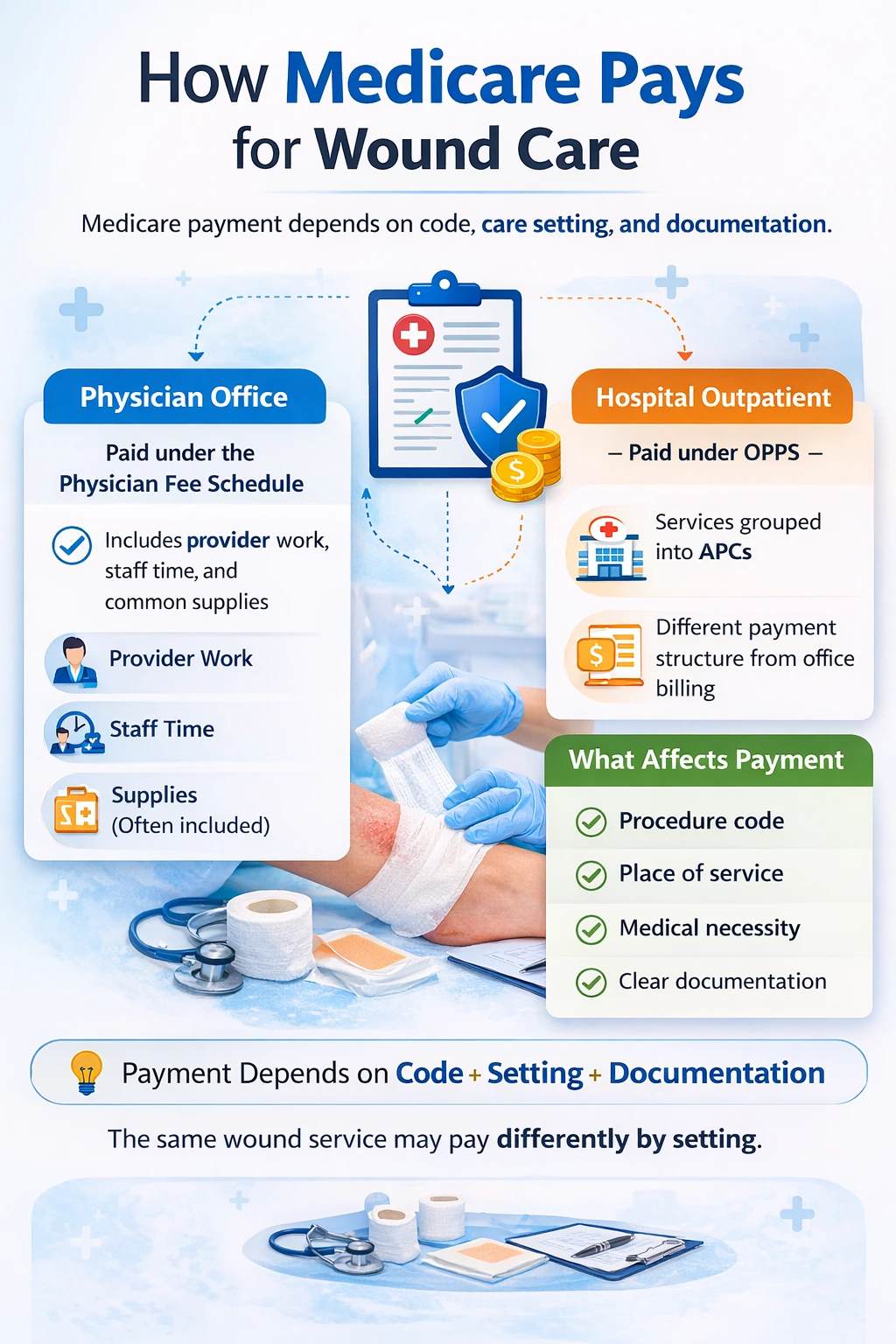
Understanding how Medicare pays for wound care helps providers plan their billing strategy. Medicare uses different payment structures depending on the location where treatment occurs.
When treatment occurs in a physician office, Medicare usually pays through the Physician Fee Schedule. The payment typically includes provider work, staff time, and common supplies.
Hospital outpatient departments follow the Outpatient Prospective Payment System. In this system, Medicare groups services into Ambulatory Payment Classifications. Each group has its own payment range.
Because of these differences, the same wound treatment may produce different payments in different settings. Providers should always confirm the correct place of service before submitting claims.
Accurate coding also plays a key role in wound care reimbursement. The CPT or HCPCS code must match the exact service performed. Incorrect coding often leads to denials or reduced payments.
Find Out What Medicare Will Pay You For Wound Care?
Providers should start by identifying the correct procedure code. After selecting the code, check the Medicare fee schedule for the current payment estimate. The place of service must also match the treatment location.
Next, review whether Medicare bundles supplies into the main payment. Many routine wound care supplies fall under packaged payments. Some advanced products may receive separate reimbursement depending on the policy year.
Local Medicare Administrative Contractors publish coverage guidance as well. These policies explain when services qualify as medically necessary. They also outline documentation requirements and diagnosis links.
Practices that review these rules before billing often see fewer claim denials. Proper preparation supports accurate wound care reimbursement and smoother payment cycles.
What Medicare Pays?
Medicare payment amounts change depending on the wound treatment provided. Simple wound care services typically receive lower payment levels. More complex procedures usually receive higher reimbursement.
Debridement procedures provide a common example. Surface level treatment may pay less than deeper tissue removal. The depth of treatment and wound size both affect the code selection.
Payment may also change based on where the service occurs. Office visits, wound care clinics, and hospital outpatient departments follow different reimbursement structures.
Providers should not rely on estimated payment numbers alone. Instead, they should verify the current CMS fee schedule. Regular review helps ensure accurate wound care reimbursement planning.
Medicare Wound Care
Medicare wound care coverage focuses on medical necessity. The provider must show that treatment supports healing or prevents complications. Documentation should describe the wound condition and the clinical reason for treatment.
Providers should also track wound progress during follow up visits. Medicare may question repeated services if documentation does not show improvement or medical need. Clear notes help prevent these issues.
Strong documentation improves coding accuracy as well. When clinical details appear clearly in the chart, coders can assign the correct procedure code more easily.
Surgical vs Selective Debridement
Debridement procedures often cause billing confusion. Providers must understand the difference between Surgical vs Selective Debridement.
Selective debridement removes nonviable tissue without cutting into deeper layers. Providers may use instruments such as scissors or curettes to perform this treatment.
Surgical debridement reaches deeper tissue levels. The procedure removes devitalized tissue down to subcutaneous tissue, muscle, or bone depending on the wound condition.
Documentation must clearly explain the depth of the procedure. Coders rely on this information when selecting the correct code. Accurate notes support proper wound care reimbursement and prevent coding errors.
Critical Modifiers and Compliance
Modifiers help clarify special circumstances in medical billing. However, providers must apply them carefully.
Critical Modifiers and Compliance rules require documentation support. Each modifier should reflect the actual service performed. Incorrect modifier use may trigger audits or claim denials.
Practices should review local coverage policies before applying modifiers. These policies often explain when modifiers are appropriate for wound procedures.
Strong compliance programs protect both revenue and regulatory safety. Clinics that follow documentation and coding guidelines experience fewer claim problems.
Need Help Understanding Wound Care Reimbursement?
Learn how Medicare pays providers for wound treatment, debridement, and related services.
Improving Wound Care Reimbursement
Healthcare practices can improve wound care reimbursement by following a clear workflow. The first step involves accurate documentation during the patient visit.
Providers should record wound size, location, tissue type, and treatment details. These details help coders select the correct procedure codes.
Next, the billing team should review Medicare coverage rules. Checking CMS guidance ensures the claim meets all requirements before submission.
Regular denial review also improves revenue. Denial analysis helps practices identify common errors and fix them quickly.
Practices that combine accurate coding, strong documentation, and careful billing oversight usually achieve better wound care reimbursement outcomes.
Product Billing, Skin Substitutes, And Packaged Payment
Many wound practices also struggle with product billing. Some advanced products have their own HCPCS codes, and some may receive separate payment in certain settings.
In other cases, Medicare packages the item into the procedure payment, especially in hospital outpatient billing. The reference page explains that this status can change and that practices should review the latest CMS payment files before billing those products as separately paid items. CMS also posts quarterly OPPS addenda updates, which makes routine review important for revenue safety.
This is one of the easiest places to lose money or create avoidable denials. A team may use a product correctly in patient care, but if billing staff use an old status rule, the claim can fail. A regular payment review process helps stop that problem before it starts.
Critical Modifiers and Compliance
Modifiers can protect payment when they are correct, but they can also trigger audits when used without support. In wound care, the safest rule is simple. Use only the modifier that clearly matches the service and the chart. Do not add modifiers as a habit.
Medicare contractors look closely at whether documentation supports medical need, separate work, repeat services, and correct billing relationships between procedures. Local coverage articles and billing guidance make that clear.
Compliance also means watching frequency, repeat treatment, and proof of progress. If a wound shows no clear need for the same service again and again, Medicare may question continued billing. Good compliance is not just about avoiding penalties. It helps you keep clean claims and faster payment.
This is where your Denial Management Services internal link belongs naturally because denied wound claims often trace back to modifier use, missing chart detail, or weak medical need language.
Documentation Tips That Help Wound Care Reimbursement
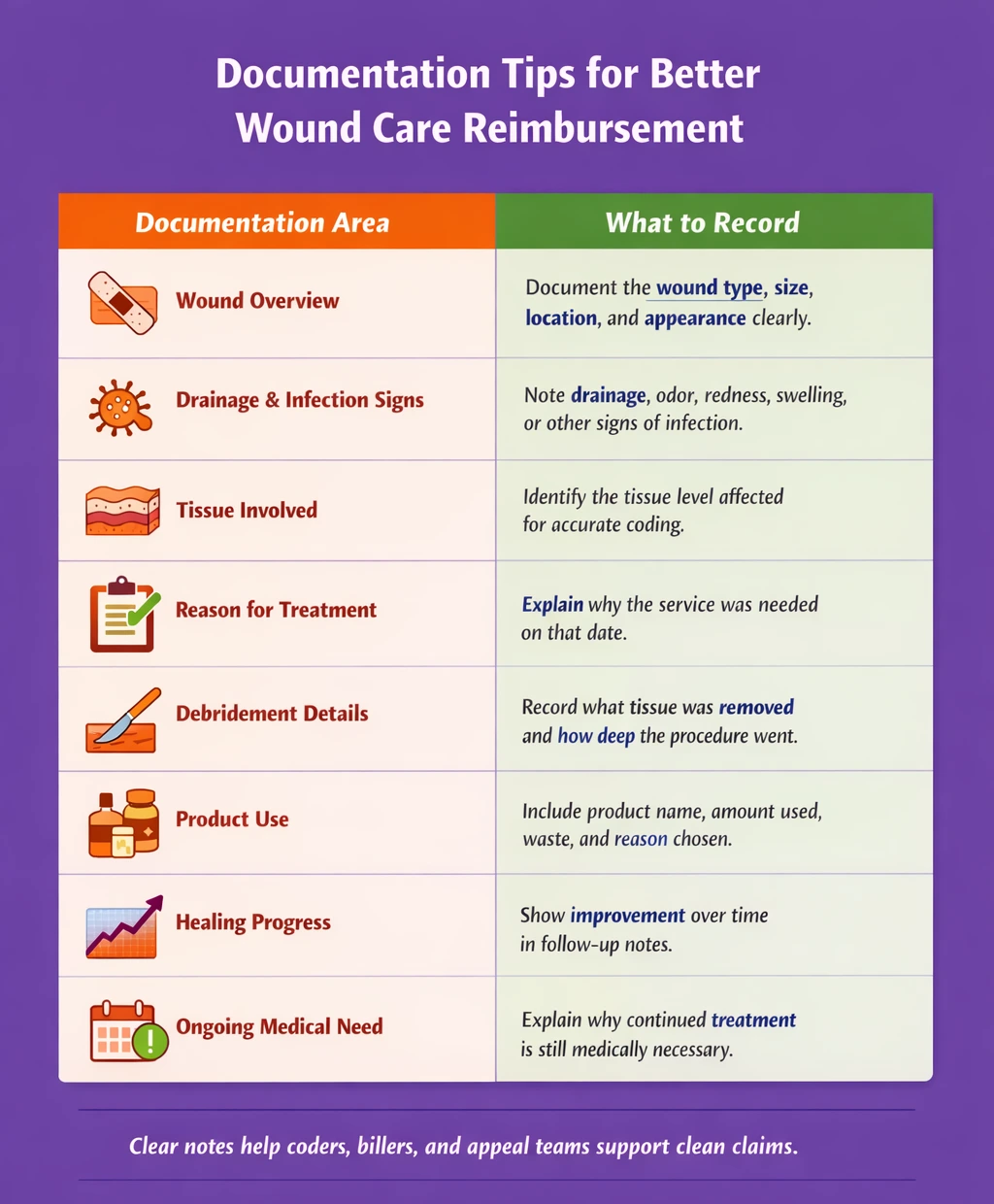
The chart should tell a clear story from start to finish. State the wound type, size, location, appearance, drainage if relevant, signs of infection if present, tissue involved, and why the service was needed on that date.
- If you perform debridement, describe what you removed and how deep you went.
- If you apply a product, record the product name, amount used, waste if required, and why that treatment was chosen.
- If the wound is healing, show progress.
- If the wound is healing, show progress.
- If it is not healing, explain why continued treatment is still needed.
Clear notes support coders, billers, and appeal teams. Weak notes force everyone to guess. Medicare rarely pays well when the record leaves room for guessing.
A Simple Billing Workflow For Providers
A good wound billing workflow starts before the claim. Verify the code, the setting, and the current payment rule. Match the diagnosis to the service. Review local coverage rules. Make sure the note shows medical need and full procedure detail. Then check whether supplies or products are separately payable or packaged.
After submission, track denials by code, provider, payer edit, and reason so you can correct trends early. That kind of clean workflow improves wound care reimbursement over time because it reduces repeat mistakes and supports faster correction when rules change.
For official CMS Fee Schedules. CMS website at: https://www.cms.gov/medicare/payment/fee-schedules/physician
Final Thoughts
Wound care reimbursement gets easier when you stop looking for one fixed payment number and start looking at the full payment picture.
Medicare pays based on code, setting, product status, medical need, and local rules. Providers who document well, code carefully, and review current CMS guidance usually see fewer denials and better payment results.
If you want cleaner claims, stronger chart support, and fewer lost dollars, wound care billing should be treated as a revenue strategy, not just a back office task.
FAQ
How Medicare Pays for Wound Care
Medicare pays for wound care through different systems based on where the service takes place. Office services usually follow the Physician Fee Schedule, while hospital outpatient services follow OPPS and APC payment logic. Local Medicare contractor rules also shape whether the claim is covered and what documentation must appear in the chart.
Find Out What Medicare Will Pay You For Wound Care?
You can find the likely payment by checking the CPT or HCPCS code in the current Medicare fee tools, then matching it to the place of service and any local coverage rule. You should also confirm whether supplies or products are paid separately or packaged into the main service.
What Medicare Pays?
Medicare does not pay one single amount for every wound service. Payment changes by code, setting, documentation, local area, and yearly CMS updates. That is why current fee schedule review is important before you estimate revenue.
Does Medicare cover wound debridement?
Yes, Medicare may cover wound debridement when the service is medically necessary and the chart supports the code billed. Coverage and payment depend on the wound condition, the type of debridement, and the local contractor rules.
Why do office and hospital payments differ for the same wound service?
They differ because Medicare uses different payment systems for different care settings. In many office claims, overhead costs are built into the provider payment, while hospital outpatient billing may split the professional and facility portions.
Are wound care supplies always paid separately?
No, many routine supplies are bundled into the main payment. Some advanced products may have separate payment, but that depends on current status and setting.
What documentation does Medicare expect for wound care claims?
Medicare expects clear proof of medical need, wound details, treatment performed, and progress over time. Local coverage articles often explain the exact chart elements needed for review.
Can a wound care claim deny even when the code is valid?
Yes. A valid code can still deny if the diagnosis does not support the service, the documentation is weak, frequency rules are exceeded, or local coverage requirements are not met.
Do Medicare payment rules for wound care change every year?
Yes, CMS updates payment rules, fee schedule details, status indicators, and outpatient files regularly. Practices should review current year tools instead of relying on older payment assumptions.
What is the best way to improve wound care reimbursement?
The best way is to combine strong documentation, accurate coding, current fee review, and fast denial follow up. When clinical notes and billing rules match, claims become easier to defend and payment becomes more predictable.