

The timely filing limit in medical billing is the period a payer allows a healthcare provider to submit a claim. When a practice misses that deadline, the payer may refuse payment even if the provider delivered covered care. Understanding the rule helps staff protect revenue and avoid unnecessary patient billing problems.
There is no single filing limit for every insurance company. The deadline depends on the patient plan, provider agreement, claim type, and applicable program rules.
Table of Contents
ToggleUnderstanding the Timely Filing Limit in Medical Billing
A filing deadline tells the billing team when the payer must receive a claim. Many plans count from the date of service, but some situations use another starting point. Institutional claims, secondary claims, and retroactive coverage may follow specific rules.
The timely filing limit in medical billing concerns submission, rather than the time a payer takes to issue payment. A claim can arrive within the allowed period and still need additional review.
Think of the deadline as the last acceptable date, rather than a target submission date. Sending claims promptly leaves time to fix registration mistakes, resolve coding questions, and correct rejected files.
How the Claim Submission Deadline Works

The claim submission deadline usually depends on payer receipt. A billing system may show that staff created or exported a claim, but that record alone may not prove the payer accepted it.
For example, imagine a hypothetical plan that allows 90 calendar days after the service date. A visit takes place on January 10. Staff should calculate the deadline using that plan’s counting instructions, record it in the billing system, and submit well before it.
Some policies state calendar days, while others use months or a calendar year. These terms can produce different deadlines. Do not replace a rule expressed as one year with a fixed number of days.
A rejection can complicate the timeline. If the clearinghouse rejects a claim before the payer receives it, the practice may lack evidence of timely payer receipt. Correct the issue immediately, resubmit, and confirm acceptance. Never assume the first transmission automatically protects the claim against every filing limit.
Good medical billing services connect submission activity with payer responses. That connection lets staff identify claims that never reached the insurer, rather than discovering them months later in an aging report. A sent file deserves follow up until the team knows what happened to it.
Timely Filing Requirements by Insurance Plan
Timely filing requirements vary across insurance products. Two patients may carry cards with the same insurer name but have different plan rules. The provider agreement may also affect the deadline.
Original Medicare generally requires claims to reach the correct Medicare Administrative Contractor no later than one calendar year after the date of service. CMS allows limited exceptions. Its official Medicare timely filing guidance explains the general rule. Do not automatically apply it to Medicare Advantage plans.
Commercial insurance deadlines depend on the payer policy and applicable agreement. A deadline you find in an online article may describe another product, an older contract, or a different provider category.
Medicaid filing rules differ by state and program. A Medicaid managed care organization may use a different process from the state program. Review the relevant billing manual and payer instructions, especially when a patient receives retroactive eligibility or another insurer pays first.
Keep a payer reference that lists original claim limits, corrected claim limits, appeal deadlines, and any secondary billing rules. Add the policy source, effective date, and last review date.
What Causes a Timely Filing Denial?
A timely filing denial occurs when the payer determines that a claim arrived outside its allowed period. Sometimes the office truly filed late. In other cases, the payer overlooked an earlier accepted submission or staff sent a replacement without the required reference.
Delayed charge entry is a common starting point. Providers may finish notes late, charges may remain in an incomplete queue, or staff may wait for missing information without assigning a follow up date.
Incorrect insurance details can send a claim to the wrong payer. The office may spend weeks following up before discovering that the patient changed plans. Reliable insurance eligibility verification services help identify active coverage and payer details early, although eligibility verification does not guarantee claim payment.
Unworked rejections create another risk. A claim can remain in the billing system with a sent status even though a response shows missing information. Staff should review rejection reports promptly and assign every unresolved item an owner.
Repeatedly resubmitting the same claim does not solve a timely filing denial. It may create duplicate responses while the underlying issue remains. Read the denial reason, confirm the applicable policy, and choose the correction, reconsideration, or exception route that the payer permits.
How to Document Proof of Timely Filing
Proof of timely filing should show that the correct payer received the relevant claim within the allowed period. Useful records may include payer claim acknowledgments, portal confirmations, claim control numbers, and reports that identify accepted transactions. The strongest evidence connects a specific patient claim with a dated payer response.
A clearinghouse batch report may show that the office transmitted a file, but the payer may require additional evidence of receipt. Review the response details rather than relying on a summary label.
For paper claims, retain the documentation the payer recognizes, such as delivery tracking and a copy of the submitted claim. Proof that a package arrived does not necessarily prove the insurer received every claim correctly. Follow the payer’s evidence requirements and organize records so staff can retrieve them quickly.
Protect patient information when storing submission evidence. Use approved systems with appropriate access controls instead of scattered email attachments or personal folders. Link the acknowledgment to the account and retain it according to your practice policy.
When staff call the payer, document the date, representative, reference number, and explanation. Ask which evidence the payer needs and where to send it.
A Practical Checklist for Filing Claims on Time
- Confirm the payer policy and correct starting date
- Record initial, corrected claim, and appeal deadlines separately
- Submit early and review every rejection
- Save claim specific proof of payer receipt
- Assign an owner and next action for unresolved claims
Initial claim submission
For an initial claim, confirm the applicable deadline before submission. Review demographics, coverage, charges, codes, and required authorization details, then monitor the acceptance response.
Corrected claims and replacements
Corrected claims and replacements may follow a separate filing window and require the original claim number or a specific submission indicator. Check the instructions before resending. An earlier timely claim does not create unlimited time for corrections, and a correction does not automatically restart the original filing period.
Secondary insurance claims
Secondary insurance claims need careful coordination. Some payers measure the window from the primary payer’s decision, while others apply different conditions. Obtain the primary remittance promptly, confirm the secondary policy, and include the required payment information. Do not assume that waiting for primary payment suspends every secondary deadline.
Appeals and reconsiderations
Appeals and reconsiderations have their own deadlines. Track them separately from initial submission and corrected claim dates. Original Medicare generally does not treat a denial solely for late filing as an appealable initial determination. Where a recognized exception applies, ask the contractor how to request the appropriate exception review.
How to Calculate and Track Filing Dates
To calculate a deadline, first identify the correct starting date and unit of time. Check the service date, claim type, payer product, and applicable agreement. Enter the result in the account record along with the source.
Use reminders before the limit approaches. A practice might choose internal alerts several weeks before the payer deadline and review urgent accounts daily. Those alerts represent practice targets rather than payer rules.
Track missing charges as well as submitted claims. An aging report cannot always reveal an encounter that never entered the billing workflow. Reconcile completed visits against charges and compare submitted claims with payer acknowledgments.
How to Respond to a Timely Filing Denial
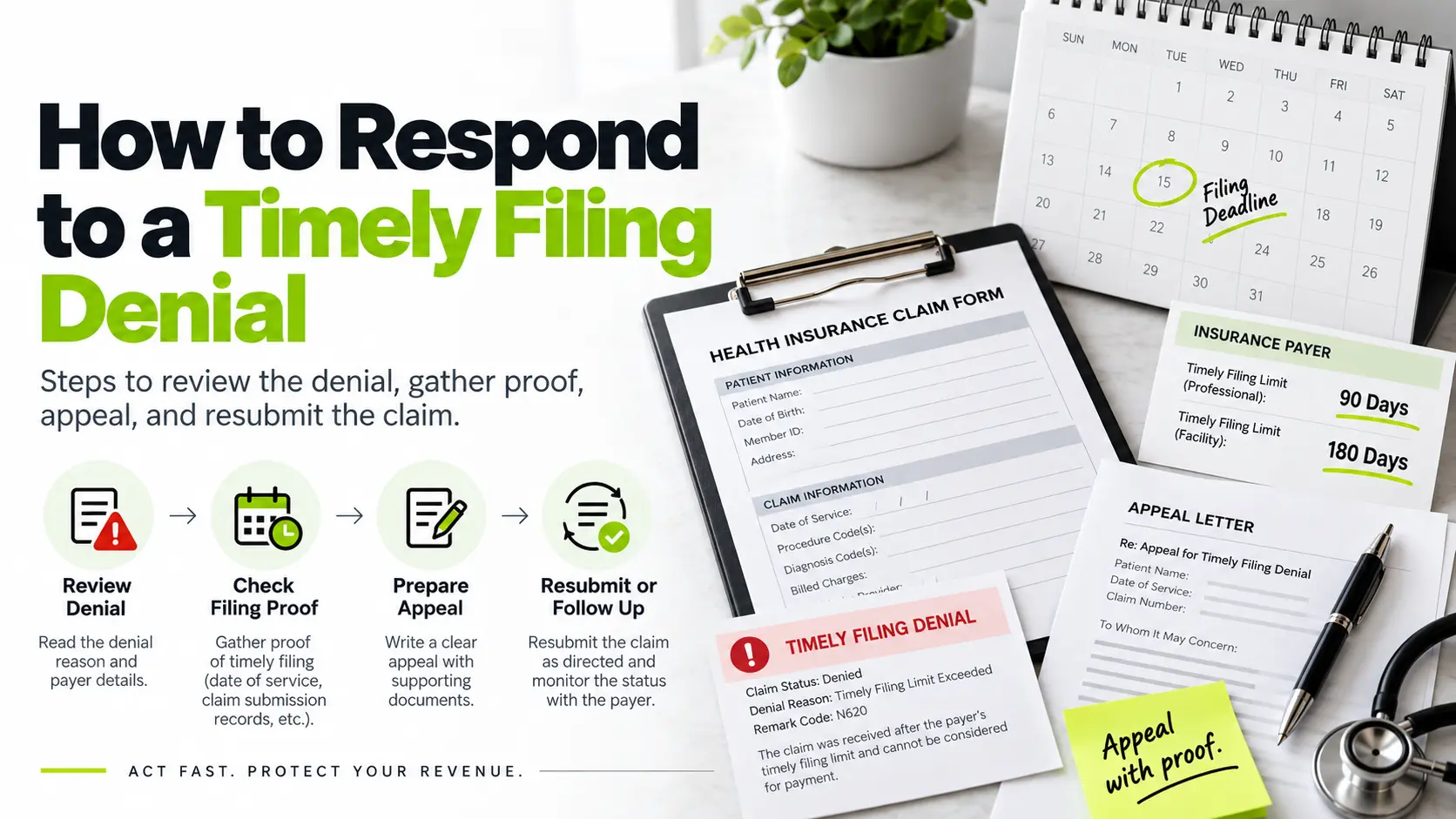
When a timely filing denial arrives, compare the payer receipt date with your evidence. Check the service date, plan, claim number, and original submission history. Confirm whether the denial concerns the original claim, a replacement, or another transaction.
If evidence supports timely receipt and the payer permits reconsideration, send a focused explanation with the required documents. Identify the claim, explain the disputed timeline, and request review under the relevant policy. Follow the payer’s submission method and track the response. Evidence strengthens the request but does not guarantee reversal.
If the practice missed the deadline, check whether a documented exception applies. CMS recognizes limited Medicare exceptions involving specified administrative errors or retroactive coverage situations. An internal staffing shortage is not automatically an exception. Our denial management services support investigation of recoverable denials and recurring workflow gaps.
How to Prevent Missed Claim Submission Deadlines
Prevent missed claim submission deadlines by setting a regular billing rhythm. Complete charge entry promptly, submit claims frequently, and review acceptance reports consistently. Every unresolved claim should have a responsible person and a next action date.
Use a separate work queue for claims approaching their limits. Sort by the earliest deadline instead of the highest balance alone. A smaller claim with only a few days remaining may need faster action than a larger claim with several months available.
Review the causes of late filing every month. Look for delays in documentation, insurance corrections, rejection handling, and secondary billing. Share specific findings with the team responsible for the issue.
How Timely Filing Supports Your Revenue Cycle
Timely submission supports cash flow because it gives the payer an opportunity to process the claim sooner. It also preserves time for corrections and follow up. However, meeting the deadline alone does not establish coverage, medical necessity, or payment. The claim must still satisfy the payer’s other requirements.
Do not automatically transfer a late filing balance to the patient. Review the applicable contract and program rules before assigning responsibility. Provider filing errors often affect what the practice can collect. Make a documented adjustment decision instead of sending a patient statement simply because the insurer denied the claim.
Medical Billing Help supports practices with claim submission, rejection review, payer follow up, and reporting. Our revenue cycle management services connect these activities so teams can identify unresolved claims and address submission problems before they become recurring revenue losses.
Final Thoughts
The timely filing limit in medical billing deserves attention from the moment a practice provides care. Verify the correct rule, submit early, confirm payer receipt, and preserve evidence. Track correction and appeal windows separately. A consistent process gives staff a clearer workload and protects revenue that the practice has already earned.
Need Help With Timely Filing?
Our billing team helps practices track filing deadlines, review rejected claims, and follow up on payer responses. Contact Medical Billing Help to discuss a more reliable claim submission process for your practice.
FAQs
What is the timely filing limit in medical billing?
It is the period a payer allows for receiving a claim. The limit depends on the plan, provider agreement, claim type, and applicable program rules. Verify the correct policy before calculating the deadline.
What is the general Medicare filing deadline?
Original Medicare generally requires receipt by the correct Medicare Administrative Contractor within one calendar year after the date of service. Limited exceptions apply. Medicare Advantage plans may follow different instructions, so check the relevant plan.
Does a rejected claim count as timely filing?
Not necessarily. A clearinghouse rejection may mean the payer never received the claim. Correct the issue quickly and obtain an acceptance response. Review the payer policy to determine which evidence establishes timely receipt.
Can I appeal a timely filing denial?
Some payers allow reconsideration with evidence of timely receipt or a recognized exception. Original Medicare generally does not allow an ordinary appeal solely for late filing. Ask the contractor about exception review when the facts support it.
Do corrected claims have the same filing limit?
They may have a different window and submission requirements. Check the payer instructions, include the original claim reference when required, and record the correction deadline separately. Never assume a replacement creates a new filing period.