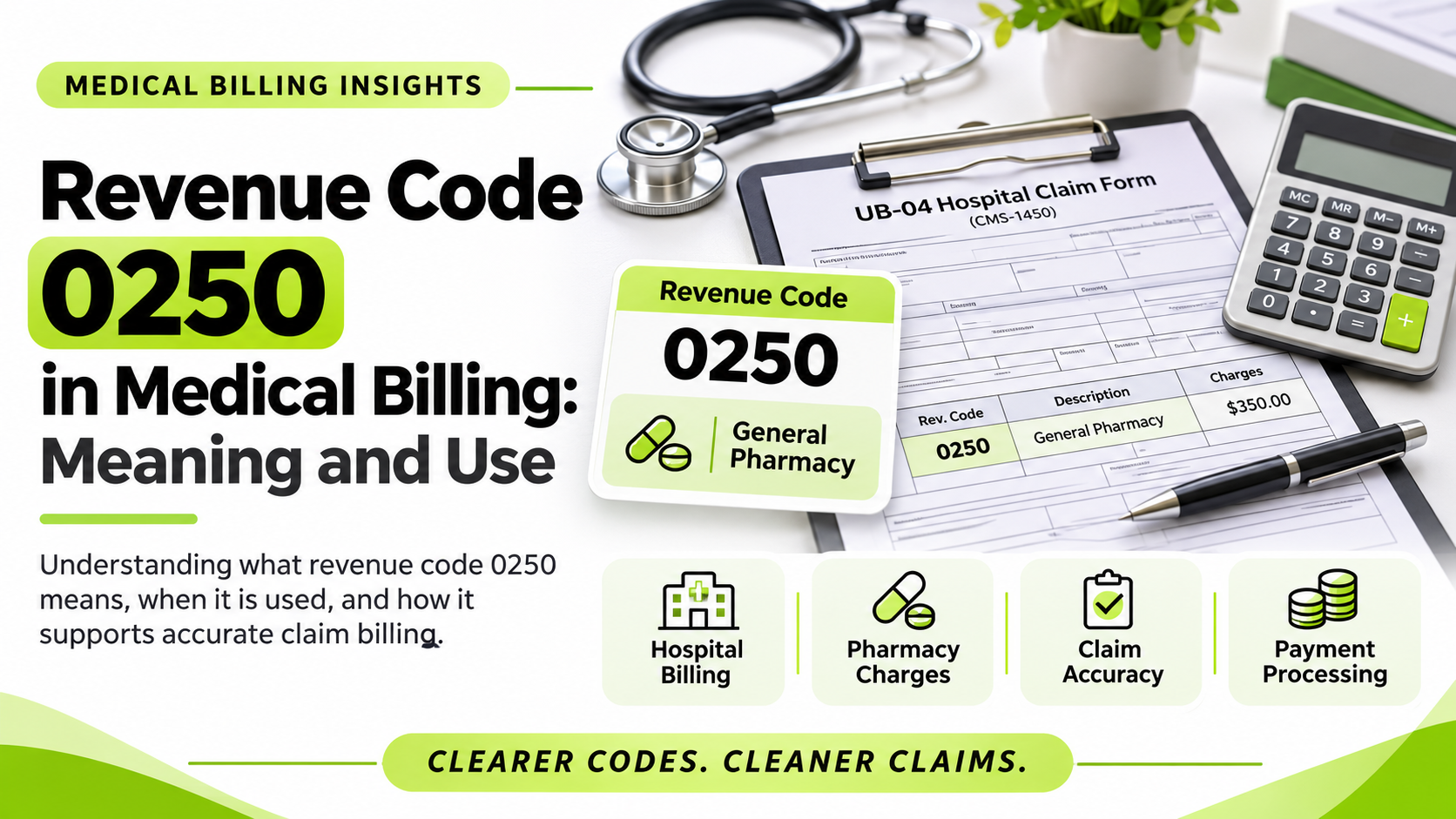
Revenue code 0250 identifies general pharmacy charges on an institutional medical claim. It helps explain the category of a facility charge, but it does not identify a specific medication, establish coverage, or guarantee separate reimbursement.
This guide explains how the code fits into hospital pharmacy billing, why it differs from CPT and HCPCS codes, and what staff should check before submission. Understanding these relationships helps billing teams investigate claim edits without assuming that one pharmacy code works for every medication or setting.
Table of Contents
ToggleWhat Is Revenue Code 0250?
Revenue code 0250 belongs to the pharmacy revenue code family. Facilities use revenue codes to classify accommodation and ancillary charges on institutional claims.
On the paper CMS 1450 form, commonly called the UB 04, revenue codes appear in Form Locator 42. Electronic institutional claims use the 837I transaction.
The National Uniform Billing Committee maintains revenue codes. The official CMS institutional revenue code guidance explains their relationship to claim charges and supporting procedure information. Use current coding resources and the payer’s applicable instructions when selecting the code for a particular claim.
0250 CPT Code: Why the Terms Are Different
The search phrase 0250 CPT code can cause confusion because 0250 is a revenue code, not a CPT procedure code. Revenue codes categorize facility charges. CPT codes describe medical procedures and services, while HCPCS Level II codes can identify drugs, supplies, and other items.
A pharmacy claim may therefore require more than one kind of identifier. The revenue code identifies the charge category, and a required HCPCS code identifies the billed drug or item more specifically. An NDC may identify the drug product.
Do not select a random CPT code to accompany 0250. Determine whether the payer requires a supporting CPT or HCPCS code for the service and claim type. Then use the code that the documentation and current instructions support. Some payer edits require detail that a general pharmacy label cannot provide.
Medication administration is another distinct issue. The drug charge and a documented administration service may require separate review under the applicable rules. Revenue code 0250 does not itself identify an injection, infusion duration, or administration procedure. Check the relevant coding instructions before reporting those services.
If a payer message refers to a missing procedure identifier, investigate the actual edit instead of searching for a universal 0250 CPT code pairing. Our medical coding services help teams compare submitted details with the documented service and identify information that needs clarification.
Revenue Code 0250 vs 0636
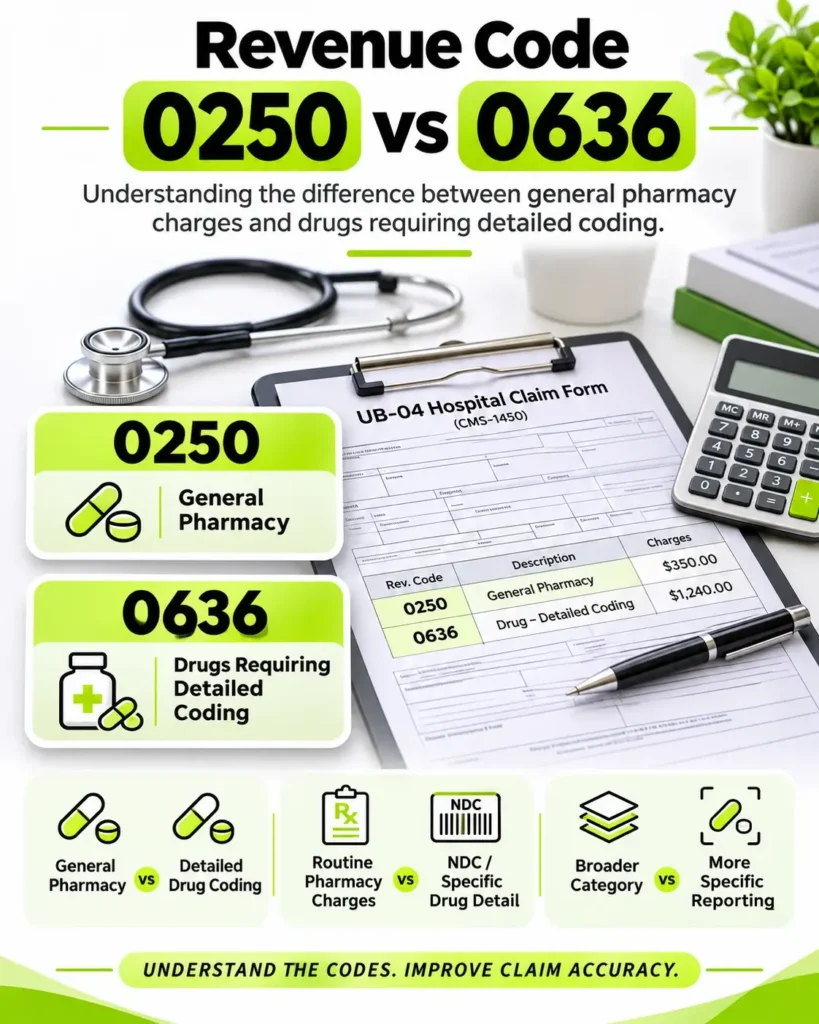
When reviewing revenue code 0250 vs 0636, remember that 0250 describes general pharmacy charges, while 0636 concerns drugs requiring detailed coding. The choice depends on the applicable reporting instructions and medication charge.
A hospital may need a specific HCPCS code and other detail for a drug line that falls under 0636. Another situation may support a general pharmacy charge. Verify the payer policy, claim setting, and service before changing the revenue code. A payment problem alone does not justify switching categories.
Do not assume that using 0250 always removes HCPCS or NDC requirements. For example, North Carolina Medicaid has published requirements for both identifiers on specified outpatient institutional pharmacy claim lines, including the 025X family. Confirm current instructions for the actual plan rather than generalizing from another payer’s claim.
An inpatient hospital claim and an outpatient hospital claim can apply different payment and reporting rules. A medication charge may contribute to a broader facility payment rather than create a separate payment. The revenue category alone does not determine whether the payer will reimburse the drug independently.
Revenue code 0250 vs 0636 review should involve the facility’s pharmacy, coding, and billing teams when the mapping is unclear. Confirm the medication, documentation, and payer instruction together.
Common Billing Errors With Revenue Code 0250
Common billing errors with revenue code 0250 include using a general category without checking required detail, mismatching supporting identifiers, and reporting quantities incorrectly. Begin with the payer’s actual response. A rejected line, denied charge, and bundled payment may look similar on an aging report but require different actions.
An incorrect charge description mapping can send the wrong revenue code repeatedly. Review how the facility’s charge system links medication items with revenue categories and supporting codes.
Missing or mismatched drug identifiers can also cause trouble. When the payer requires an NDC, confirm the actual product and required reporting format. Check that any associated HCPCS code matches the billed item.
Duplicate medication charges create another avoidable issue. Compare pharmacy records, administration documentation, returns, and account entries before billing. Staff should reconcile corrections and reversals so the claim reflects the charge that remains valid. Repeating a charge does not become appropriate because the payer previously rejected it.
When a payer questions a pharmacy line, use denial management services to help investigate the reason and available next step. Correct supported claim errors or pursue the applicable review route. Do not move an unresolved facility billing error to the patient automatically.
Hospital Pharmacy Billing Documentation
Reliable hospital pharmacy billing starts with records that support the medication charge. Relevant information may include the order, drug details, date, dose, route, and administration or dispensing record. The documentation needed depends on the service and payer.
Billing units may differ from the clinical dose or package quantity. Check the supporting drug code’s unit definition when it applies, then calculate the billed quantity from the documented amount. Avoid assuming that one vial always equals one billing unit or that every drug uses the same unit basis.
If the payer requires NDC data, verify the product identifier, quantity, and unit of measure under its instructions. HCPCS units and NDC quantities can describe different things. Staff should reconcile them carefully rather than copying one number into every quantity field. Document how they calculated the reported amounts.
Review unused drug reporting separately when relevant. Requirements can depend on the drug, container, payer, and claim setting. Do not assume the general pharmacy revenue code authorizes billing every unused amount. Follow the applicable rules and retain documentation supporting any reported wastage or required modifier.
Clear records also support later payment research. Keep the claim details, supporting medication information, payer response, and any correction history accessible to authorized staff.
A Pharmacy Claim Review Checklist
- Confirm institutional claim type and payer instructions
- Verify the pharmacy revenue category and supporting identifiers
- Reconcile medication records with charges and quantities
- Check billing units, required modifiers, and duplicate lines
- Review acceptance reports and investigate payment outcomes
Confirm the claim setting
Confirm the claim setting before choosing a revenue code. Identify whether the facility is billing inpatient or outpatient care and verify the appropriate institutional claim type.
Review the drug and supporting codes
Review the medication and every required supporting code against the actual record. Confirm the payer’s HCPCS and NDC expectations for that service date.
Check quantities and units
Check quantities and units before submission. Compare the ordered amount, documented administration or dispensing, charge entry, and payer reporting definition. Investigate discrepancies rather than changing a quantity just to pass an edit. The final line should reflect both the service record and applicable billing instructions.
Validate the complete claim line
Validate the complete claim line, including the revenue category, supporting identifiers when required, dates, units, charges, and applicable modifiers. Review other lines for duplication or related adjustments. A correct 0250 entry cannot compensate for conflicting information elsewhere in the claim.
How Hospitals Use Revenue Code 0250
Hospitals use revenue code 0250 to classify eligible general pharmacy charges within their institutional billing workflow. The process usually connects pharmacy activity with the charge system, coding review, and claim generation.
For example, a hospital records a medication charge during a patient’s encounter. Before selecting 0250, the team checks whether general pharmacy classification is appropriate or more detailed reporting applies. It then adds the supporting data the payer requires.
Reconcile the pharmacy record with the final account before releasing the claim. Medication changes, cancelled orders, returns, and corrected quantities can affect charge accuracy. A consistent review helps prevent a valid pharmacy category from carrying an invalid amount or an item the hospital did not actually provide.
How Payers Review Pharmacy Charges
A payer considers the entire claim when evaluating pharmacy charges. Coverage, benefit rules, medical necessity, authorization requirements, claim type, and the applicable payment arrangement can affect the result. Revenue code 0250 identifies a category; it does not override those conditions or establish a separate reimbursement rate.
Review the remittance when a pharmacy line produces no separate payment. The payer may have packaged the charge into another payment, denied the line, or applied another adjustment. Determine which explanation fits before describing the account as underpaid or submitting another claim.
Our payment posting and reconciliation services help practices compare the payer response with account entries. The team should distinguish a supported payer balance from a required adjustment, missing posting, or other discrepancy before requesting additional money.
How Medical Billing Help Supports Pharmacy Claim Reviews
Also Read: Common Medical Billing Denial Codes and How to Improve First Pass Claim Acceptance Rate. These guides explain related submission and payment issues that may affect an institutional pharmacy claim.
Medical Billing Help supports healthcare organizations with coding review, claim follow up, denial investigation, and payment reconciliation. Our medical billing services help teams identify missing details and organize the next action when a payer questions pharmacy charges or reimbursement.
For revenue code 0250 questions, a useful review should identify the claim setting, actual medication, applicable payer rule, supporting codes, and unit calculation. This approach provides a practical starting point for correction without assuming that every disputed charge needs the same revenue code or appeal.
Contact our team to discuss the pharmacy claim problems your organization faces and the support available. A focused review can clarify whether the main issue concerns charge capture, coding, submission, or payment posting. Recovery depends on the documentation, coverage, deadlines, and facts of each claim.
Electronic Submission and Claim Follow Up
Electronic institutional claims normally travel through a billing platform, clearinghouse, or payer connection that supports 837I transactions. The software transmits the data but does not decide whether 0250 fits the medication charge. Coding and billing staff remain responsible for the accuracy of the submitted information.
Confirm payer connectivity, any enrollment requirement, and support for the drug details your claim needs. Review acknowledgment reports after transmission. A clearinghouse acceptance does not prove payer payment, and a sent file may still require correction before the insurer can process it.
Track unresolved rejections and payer requests with an owner and next action date. Follow the correct replacement or review process and preserve relevant submission evidence. Repeatedly transmitting an unchanged claim can create duplicate responses while leaving the original pharmacy billing issue unresolved.
Build Accuracy Into Every Pharmacy Claim
Revenue code 0250 works best within a complete institutional claim review. Confirm the pharmacy category, use the supporting identifiers required for the setting and payer, and verify documented quantities. Accurate charge capture and consistent follow up help facilities address preventable errors and explain payment outcomes more clearly.
Need Help With Pharmacy Claim Errors?
Our team helps healthcare organizations review pharmacy claim details, investigate denials, and reconcile insurance payments.
FAQs
What services are typically billed under revenue code 0250?
The code classifies eligible general pharmacy charges on institutional claims. It does not identify a particular medicine or authorize every drug charge. Confirm whether the medication needs another pharmacy category, supporting HCPCS details, or NDC information under the applicable rules.
What companies offer electronic claim submission for revenue code 0250?
Optum offers institutional claim submission services, and Office Ally lists institutional payer connections. Confirm that the chosen service supports your payer, 837I submission, required drug fields, and enrollment needs. No clearinghouse guarantees that a 0250 line meets coverage or coding requirements.
How do hospitals use revenue code 0250 in billing processes?
Hospitals connect pharmacy charge capture with their institutional claim workflow and use 0250 when the general pharmacy category fits. Billing teams verify documentation, required drug identifiers, units, and payer instructions before submission, then review acceptance and payment responses.
Which healthcare providers specialize in using revenue code 0250 for claims?
Hospital facility billing teams, pharmacy departments, institutional coders, and revenue integrity specialists commonly handle these charges. There is no separate provider specialty defined by this revenue code. An independent clinician should not assume that institutional pharmacy rules apply to a professional claim.