

Understanding Medicare 8 Minute Rule Therapy is essential for anyone working in therapy services or medical billing. This rule directly impacts how providers bill for time based services and how much they get paid. Many providers struggle with it in the beginning, but once you understand the logic behind it, the process becomes much easier.
This guide will walk you through everything you need. You will learn how the rule works, how to calculate billable units, how to document properly, and how to avoid common mistakes. By the end, you will feel confident applying this rule in real situations.
Table of Contents
ToggleWhat is Medicare 8 Minute Rule Therapy
Medicare 8 Minute Rule Therapy is a method used to calculate billing units for time based therapy services. These services include treatments where the provider spends direct time with the patient.
The rule states that a provider must spend at least eight minutes on a service to bill one unit. If the time is less than eight minutes, that service cannot be billed.
This rule ensures fair billing and prevents overcharging. It also helps standardize how therapy services are reported across providers.
Why This Rule Exists
Medicare created this rule to bring consistency and accuracy into therapy billing. Before this system, there was confusion about how to report partial time sessions.
By setting a minimum threshold, Medicare ensures that every billed unit reflects real patient care. This aligns with Medicare billing guidelines and promotes transparency.
Understanding Timed Therapy Codes
Timed services are those that depend on how long a therapist works with a patient. These services fall under timed therapy codes and require careful tracking.
Each unit usually represents fifteen minutes of service. However, you do not need a full fifteen minutes to bill one unit. The eight minute rule allows flexibility.
Examples of timed services include therapeutic exercises, manual therapy, and gait training.
How Billable Units Are Calculated
The calculation process is based on total time spent on all timed services during a session. Medicare uses ranges to determine how many units can be billed.
Table: Time to Unit Conversion
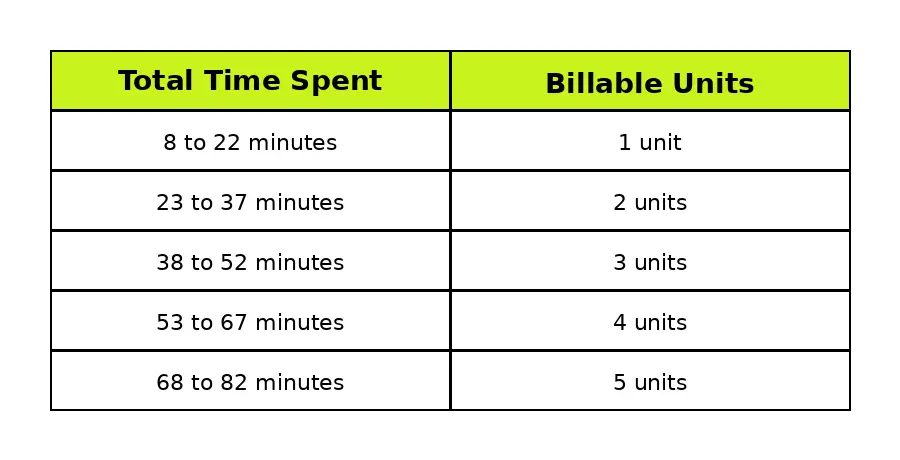
This table shows how total time translates into units. The key is to add all timed services together before assigning units.
Step by Step Example
Let’s take a detailed example to make this clear.
- A therapist provides
- ten minutes of therapeutic exercise
- fifteen minutes of manual therapy
- ten minutes of neuromuscular training
- The total time is thirty five minutes.
According to the table, thirty five minutes allows billing for two units. Now the provider must decide how to assign those units.
The service with the highest time gets priority. In this case, manual therapy receives one unit. The second unit goes to the next highest service.
Table: Unit Distribution Example
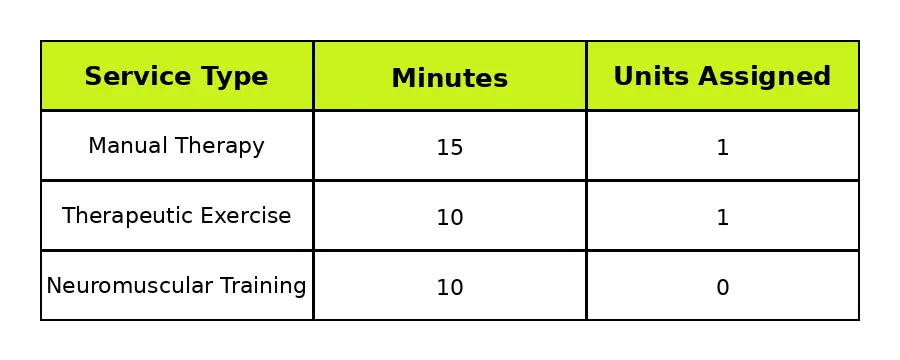
This approach ensures fair distribution based on time.
Difference Between Timed and Untimed Services
Not all therapy services follow the eight minute rule. Untimed services are billed as one unit regardless of time spent.
For example, evaluations and re evaluations are untimed. You bill one unit even if the session lasts longer.
Table: Timed vs Untimed Services
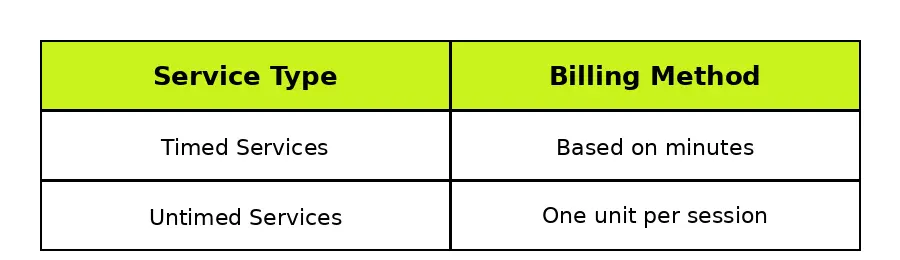
Understanding this difference helps prevent billing errors.
Documentation Requirements for Compliance
Proper documentation is critical for accurate billing. Medicare expects providers to record detailed notes for each session.
This connects with therapy documentation requirements, which ensure that services are medically necessary and properly recorded.
Your documentation should include the type of service, total time spent, and patient response. You should also record start and end times when possible.
Without clear documentation, claims may be denied or questioned during audits.
You can also stay updated by reviewing the official Medicare billing guidelines to ensure your billing process follows the latest rules and requirements.
Common Errors in Medicare 8 Minute Rule Therapy
Many billing issues arise from small mistakes. These errors can lead to denied claims or delayed payments.
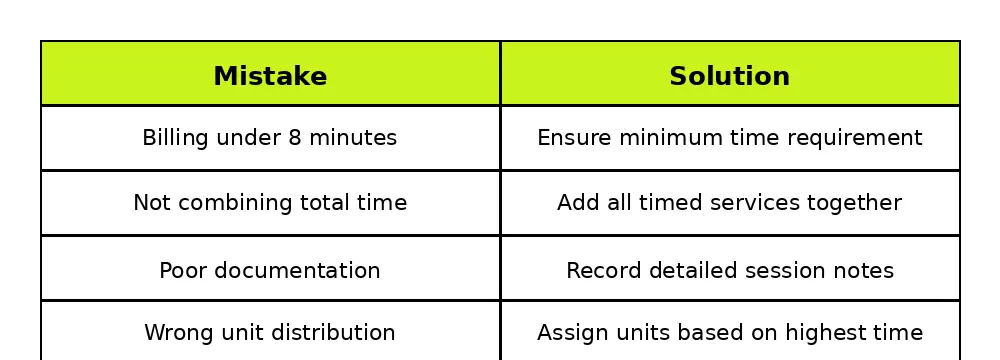
One common issue is billing for less than eight minutes. This is not allowed and will result in rejection.
Another mistake is failing to combine total time across services. Some providers calculate each service separately, which is incorrect.
Incomplete documentation is also a major problem. If time is not recorded clearly, the claim may not be approved.
Need Help With Medicare 8 Minute Rule Therapy?
Get clear guidance on billing, units, and documentation to avoid denials.
Table: Common Mistakes and Solutions
How the Rule Impacts Revenue
Accurate use of Medicare 8 Minute Rule Therapy can improve revenue. When you bill correctly, you reduce claim denials and speed up payments.
Incorrect billing can lead to financial loss. It may also trigger audits, which take time and resources.
By following the rule carefully, providers can protect their income and maintain compliance.
Role in Daily Practice
In real practice, therapists and billing teams must work together. The therapist records time and services, while the billing team ensures correct coding.
This is especially important for clinics following physical therapy billing rules. Clear communication helps avoid errors and improves workflow.
Medicare vs Other Insurance Rules
Not all insurance companies follow the same system. Some use different methods for calculating units.
Always verify payer policies before billing. Do not assume that all insurers follow Medicare rules.
This awareness helps prevent claim rejections and confusion.
Difference Between 8 Minute Rule and Rule of Eights
The eight minute rule is specific to Medicare. It uses total time across all services to determine units.
The rule of eights is a different method used by some providers. It calculates units based on individual service time rather than total time.
Understanding this difference is important when working with different payers.
Can You Bill for Non Treatment Time
Medicare does not allow billing for time spent on documentation alone. Only direct patient care counts toward billable minutes.
However, documentation is still essential. It supports your billing and ensures compliance.
Best Practices for Accurate Billing
To succeed with Medicare 8 Minute Rule Therapy, consistency is key. Track time during sessions instead of estimating later.
Make sure your documentation matches your billing. Review claims before submission to catch errors early.
You can also stay updated by visiting the Centers for Medicare & Medicaid Services website for official guidance.
What You Should Remember
Medicare 8 Minute Rule Therapy is a core part of therapy billing. While it may seem complex at first, it becomes manageable with practice.
By understanding time ranges, documenting clearly, and applying the rule correctly, providers can improve accuracy and reduce errors.
This leads to faster payments, better compliance, and stronger financial stability.
FAQ
What is the minimum time required to bill one unit
You must spend at least eight minutes providing a timed therapy service to bill one unit.
Can I combine time from different services
Yes, total time from all timed services is combined to determine the number of units.
Does the 8 minute rule apply to all therapy services
No, it only applies to timed services. Untimed services are billed as one unit.
What happens if I bill incorrectly
Incorrect billing may lead to denied claims, delayed payments, or audits.
How can I improve compliance
You can improve compliance by tracking time accurately, documenting clearly, and following Medicare guidelines.
Does the medicare 8 minute rule apply to commercial insurances
No, commercial insurance plans may use different rules. Always check each payer policy before billing.
How are billable units calculated
Billable units are calculated based on total time spent on all timed services using Medicare time ranges.
Does it apply to all types of therapy
It mainly applies to physical therapy, occupational therapy, and speech therapy when timed services are used.
How does it differ from the Rule of Eights
The Medicare rule uses total combined time, while the Rule of Eights may calculate units per individual service.
Can I bill for documentation time
No, you cannot bill for documentation alone. Only direct patient care counts as billable time.