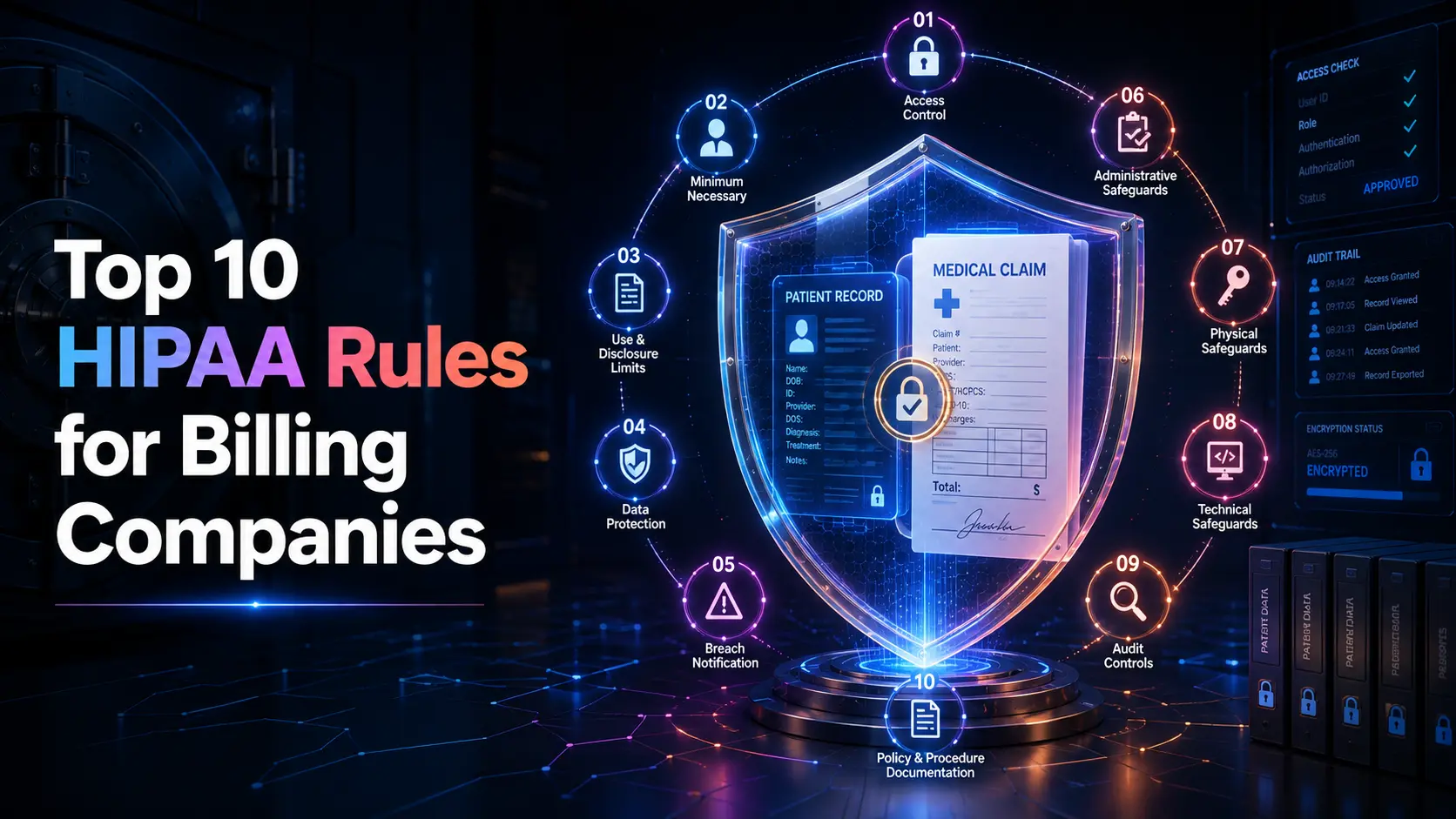
Medical billing companies handle patient names, insurance details, diagnosis codes, treatment records, and payment data every day. This information helps a practice receive payment, but it also creates a serious duty to protect patient privacy. The Top 10 HIPAA Rules for Billing Companies explain the main steps a billing team should follow when it receives, uses, stores, or shares protected health information.
Most outside billing companies act as business associates because they perform billing or claims work for healthcare providers and need access to protected health information. This means the billing company must follow the parts of HIPAA that apply to business associates. It must also follow the promises written in its contract with each provider.
HIPAA compliance is not only an IT task. It affects staff training, daily claim work, email, remote access, paper records, vendors, and incident response. A clear process helps the company protect patients while keeping claims moving through the revenue cycle.
Table of Contents
ToggleTop 10 HIPAA Rules at a Glance
Why the Top 10 HIPAA Rules for Billing Companies Matter
The Top 10 HIPAA Rules for Billing Companies help teams turn broad privacy and security duties into clear daily actions. They also help healthcare providers review a billing partner before sharing patient information.
What HIPAA Compliance for Medical Billing Companies Means
HIPAA compliance for medical billing companies means using reasonable safeguards to protect health information and limiting its use to approved billing work. The company should know where patient data enters its systems, who can see it, how it moves between teams, where it is stored, and when it should be removed.
The official HHS guidance for business associates explains that billing, claims processing, and practice management can make a company a business associate. It also explains that business associates can have direct duties under the HIPAA Privacy, Security, and Breach Notification Rules.
HIPAA Billing Requirements Begin With Written Agreements
HIPAA billing requirements begin before a billing company receives its first patient record. The provider and billing company should sign a business associate agreement that explains the allowed uses of protected health information, required safeguards, incident reporting, and the return or removal of information when the relationship ends.
A billing company should also review every vendor that may create, receive, maintain, or transmit protected health information on its behalf. If a subcontractor handles patient data, the billing company may need a suitable agreement with that subcontractor. The company cannot pass patient information to another vendor and ignore what happens next.
HIPAA Privacy Rules for Billing Companies and Patient Data
HIPAA privacy rules for billing companies control how staff members use and share protected health information. A biller may use patient data for approved payment and billing work, but should not open a record out of curiosity, discuss a patient in a public place, or share information with someone who has no valid business need.
Privacy also applies to daily communication. Staff should verify the person receiving information before discussing a claim. Screens should not expose patient data to visitors. Printed records should not remain on an open desk. Small habits can prevent large privacy problems.
HIPAA Security Rules for Billing Services and Electronic Records
HIPAA security rules for billing services focus on electronic protected health information. Billing companies should use administrative, physical, and technical safeguards that protect confidentiality, integrity, and availability. These safeguards should match the size of the company, its systems, its work, and the risks it faces.
Strong security includes access controls, secure devices, protected networks, backup plans, system monitoring, and a clear response process. A company should not wait for an attack before it checks security. Regular reviews help find weak points early.
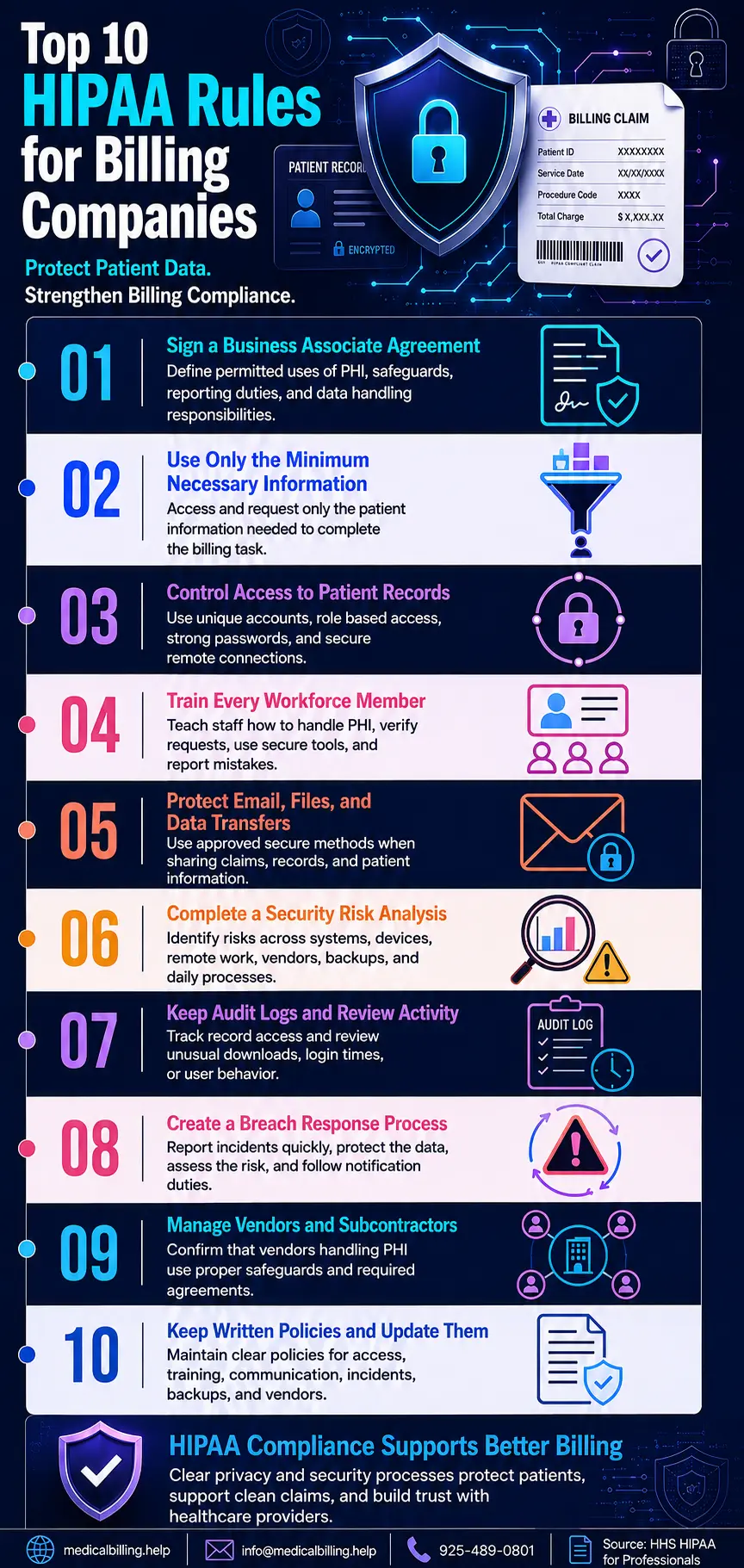
1. Sign a Business Associate Agreement
A business associate agreement defines how the billing company may use protected health information. It should describe permitted work, privacy duties, security duties, breach reporting, and the treatment of data when the contract ends. Both parties should review the agreement before sharing records.
The billing company should keep signed copies and make sure daily work matches the contract. If a new service changes how the company handles patient data, the parties should review whether the agreement also needs an update.
2. Use Only the Minimum Necessary Information
Billing teams should use only the information reasonably needed for the task. A payment poster may not need the same record access as a coder. A person checking eligibility may only need patient and coverage details. Role based access helps limit unnecessary exposure.
The minimum necessary approach also applies when a company requests information from a practice. Asking for an entire medical record when only one note is needed can create more risk. Clear request standards help staff collect the right information without collecting too much.
3. Control Access to Patient Records
Every staff member should have a unique account. The company should give access based on job duties and remove access when a person changes roles or leaves. Shared usernames make it difficult to know who opened or changed a record.
Strong passwords and added login verification can reduce the risk of stolen accounts. Staff should lock screens when they step away. Remote workers should use approved devices and secure connections. These controls support accurate work and protect patient privacy.
4. Train Every Workforce Member
Training should explain how HIPAA applies to real billing tasks. Staff need to know how to send claim information safely, verify callers, report a mistaken email, handle paper records, and avoid unsafe downloads. Training should use clear examples that fit each role.
A company should train new staff before they receive broad access and provide updates when systems, threats, or policies change. It should also keep records of completed training. Regular reminders help good privacy habits become part of daily work.
5. Protect Email, Files, and Data Transfers
Billing companies often exchange records with practices, payers, clearinghouses, and other approved partners. They should use secure methods for information that contains patient details. Staff should confirm addresses before sending a message and avoid placing sensitive data in an unprotected subject line.
The company should set rules for file sharing, downloads, portable drives, and personal email. Approved tools make it easier to control access and remove it when needed. Secure communication also supports better medical billing services because teams can exchange the information required for clean claims without exposing patient data.
6. Complete a Security Risk Analysis
A risk analysis helps the company find where electronic patient information may be exposed, changed, lost, or made unavailable. The review should cover software, devices, email, remote work, vendors, backups, physical locations, and staff practices.
After the review, the company should rank risks and create a plan to address them. It should document the process and update it when technology or business operations change. Risk analysis is not a one time form. It is an ongoing part of security management and an important part of the Top 10 HIPAA Rules for Billing Companies.
7. Keep Audit Logs and Review System Activity
Audit logs can show who opened a record, when access occurred, and what action a user took. Billing companies should enable useful logs in systems that handle electronic protected health information and review unusual activity.
For example, a large number of record downloads or access at an unusual time may need review. Logs also help the company study an incident and explain what happened. Clear monitoring protects privacy and supports responsibility across the team.
8. Create a Breach Response Process
A privacy or security incident can include a lost device, a message sent to the wrong person, stolen login details, or access by an unauthorized worker. Staff should know how to report a concern quickly without hiding mistakes.
The company should record the event, protect the information, study the risk, and follow its reporting duties. A business associate must notify the covered entity after a breach of unsecured protected health information within the required period. The written agreement may require faster notice, so staff should know the contract rules.
9. Manage Vendors and Subcontractors
A billing company may use cloud storage, support providers, software vendors, or other subcontractors. It should know which vendors handle protected health information and confirm that the required safeguards and agreements are in place before access begins.
Vendor review should continue after signing a contract. The billing company should track changes in services, access, security issues, and contract status. A weak vendor can create the same privacy risk as a weak internal process.
10. Keep Written Policies and Update Them
Written policies turn HIPAA duties into clear actions. They should cover access, communication, devices, training, risk review, incident reporting, backups, vendors, and record handling. Staff should be able to understand and follow them.
Policies should match the way the company actually works. An old policy that no longer fits current software or remote work will not guide staff well. Regular reviews help the company update controls and show that it takes compliance seriously.
How HIPAA Compliance Supports Better Billing
Strong privacy and security processes support accurate billing. Clear access roles help the right staff reach the right information. Secure communication helps practices share documents for coding and claim review. Audit logs make it easier to track work and study errors.
Compliance also supports trust. Healthcare providers want a billing partner that protects patient information while improving collections. A careful process can support revenue cycle management, reduce avoidable delays, and give practices greater confidence in outside support.
Billing companies should connect compliance work with daily quality checks. A clean claim is important, but the company must also protect the information used to create that claim. Both goals support a stable and responsible billing operation.
Build a Safer Billing Process
The Top 10 HIPAA Rules for Billing Companies give billing teams a practical foundation. Start with written agreements, limit access, train staff, secure communication, review risks, monitor activity, prepare for incidents, manage vendors, and keep policies current.
No single tool can create complete compliance. A billing company needs clear leadership, trained people, secure systems, and regular review. These steps protect patient information and support reliable service for healthcare providers. Practices that need help with claim workflows can explore our denial management services or contact our billing team.
Need Help With Secure Medical Billing?
Our billing team uses clear processes to protect patient information while supporting clean claims, denial follow up, and steady revenue cycle performance.
FAQs
Do HIPAA rules apply to medical billing companies?
Yes. An outside billing company usually acts as a business associate when it creates, receives, maintains, or transmits protected health information for a healthcare provider.
Does a billing company need a business associate agreement?
A billing company that handles protected health information for a covered entity generally needs a written business associate agreement before it receives the information.
What is protected health information in medical billing?
Protected health information can include patient names, contact details, insurance information, diagnosis codes, treatment details, account data, and other information that can identify a patient.
How often should billing staff receive HIPAA training?
Staff should receive training when they join the company and when policies, systems, threats, or job duties change. Regular reminders also help staff follow safe practices.
What should a billing company do after a possible breach?
The company should report the event internally, protect the information, study the risk, document its actions, and notify the covered entity according to HIPAA duties and the written agreement.