
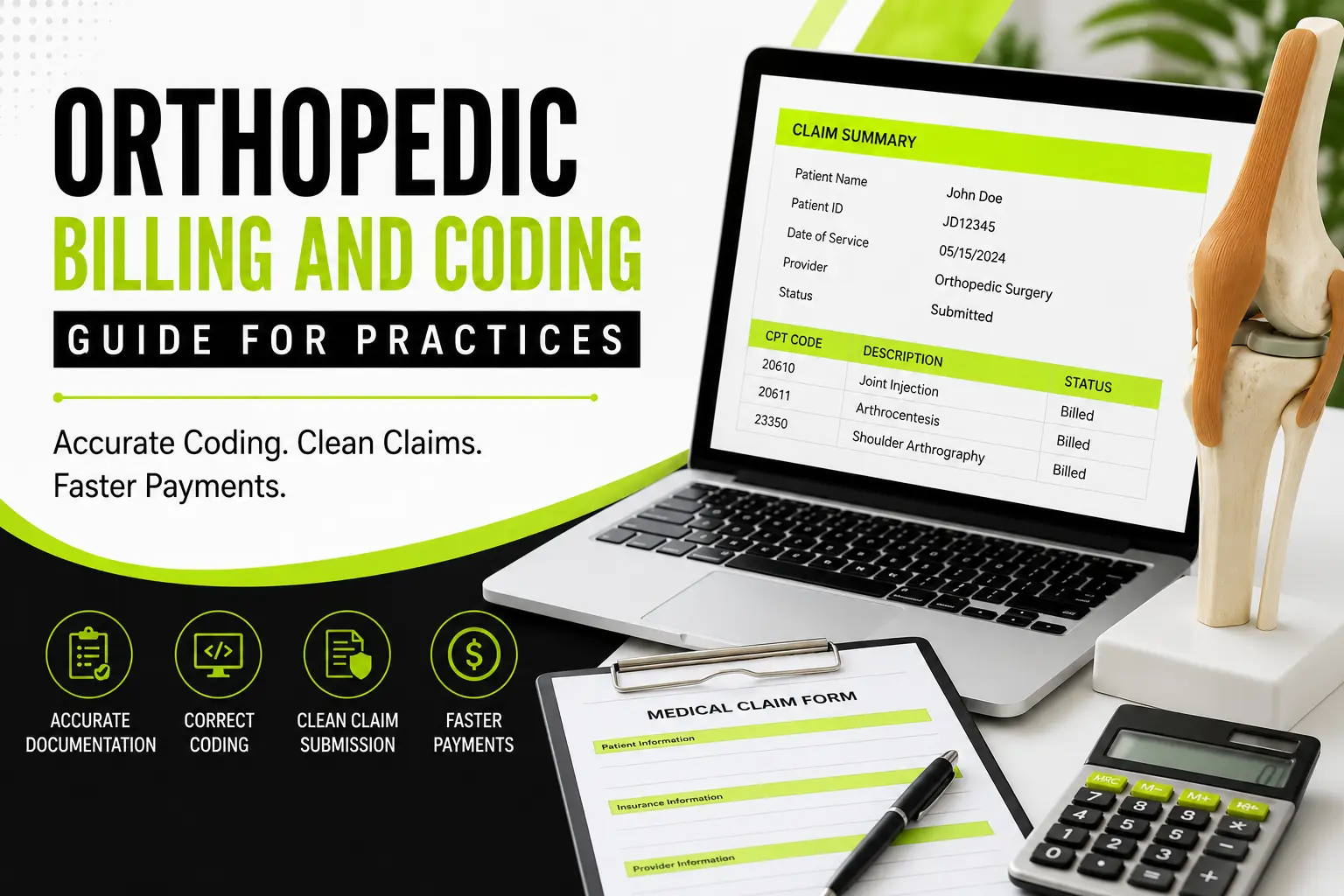
Orthopedic care is one of the most active areas in healthcare. Patients visit orthopedic practices for joint pain, bone injuries, back problems, sports injuries, swelling, limited movement, fractures, arthritis, and surgery related care. Because the services are different from patient to patient, the billing process also needs close attention.
Orthopedic Billing and Coding can be difficult because one visit may include an exam, imaging review, injection, procedure, brace, surgery plan, or follow up care. A simple coding mistake can delay payment. A missing note can cause a denial. A wrong modifier can lead to underpayment or payer review.
A strong billing process helps the practice submit cleaner claims and reduce avoidable denials. The process starts before the patient sees the provider. The front desk should collect the correct patient and insurance details. The provider should document the visit clearly. The coding team should select the right codes. The billing team should submit the claim, post payments, manage denials, and follow up until the practice receives the correct payment.
This guide explains how orthopedic practices can manage billing and coding with more care. It also explains how documentation, claim review, denial management, and A/R follow up can protect revenue.
Table of Contents
ToggleWhy Orthopedic Billing Needs Careful Review
Orthopedic billing is not like basic office visit billing. Many orthopedic services involve body parts, laterality, procedure details, imaging, injections, supplies, surgery, and global period rules. The billing team needs to understand what happened during the visit before it can prepare the claim.
For example, a knee pain visit may include an exam, X ray review, diagnosis, treatment plan, and possible injection. A shoulder visit may include imaging review, range of motion testing, and a decision for surgery. A fracture visit may include treatment, supplies, and follow up care. Each case needs a careful review.
Payers also follow different rules. Medicare may process a service one way, while a commercial payer may follow another rule. Workers compensation claims may need extra forms or records. Some plans may require prior approval before a procedure or surgery.
A practice should not send claims based on guesswork. It should build a process that checks the patient record, payer rule, diagnosis, procedure, modifier, and claim details before submission.
Documentation Comes First
Good billing starts with good documentation. The provider note should explain why the patient came in, what the provider found, what service was done, and what plan was given. If the record does not explain the service clearly, the coder may not have enough support to choose the right code.
The note should show the affected body part and side of the body. It should also describe the medical need for the service. If the provider performs a procedure, the note should include the reason for the procedure, the site, the method, and the patient response.
The coder should not assume details that are not written. If the note says the patient had joint pain but does not show which joint was treated, the claim may become weak. If the note says an injection was given but does not show the medicine or site, the billing team may need clarification.
Holding a claim for review may take extra time, but it is better than sending a claim that later gets denied. Clean documentation helps create a clean claim.
cpt injection Coding in Orthopedic Claims
A cpt injection service may look simple, but it can create billing problems when the details are not clear. The coder should confirm the treated joint, the side of the body, the medicine used, and whether imaging guidance was used.
The provider should document the medical reason for the injection. The note should also show that the patient received the service and how the patient handled it. If medication was used, the drug name and amount should be clear.
Some payers may require drug details. Some may require a modifier for the side of the body. Some may review whether the injection was part of another service on the same day.
If the provider also bills an office visit on the same date, the note should support a separate and important evaluation beyond the normal work of the injection. CMS billing guidance for some injection claims explains that modifier 25 may apply when a separate evaluation and management service is supported by the record.
The main point is simple. The claim should match the record, and the record should support the claim.
arthrocentesis cpt code and Joint Services
The arthrocentesis cpt code selection depends on the joint or bursa treated and whether the provider used guidance. Joint aspiration means the provider removes fluid. Joint injection means the provider places medicine or another substance into the joint or bursa. In some cases, the same code family can describe aspiration, injection, or both when the rule applies.
The coder should know whether the service involved a small, medium, or large joint. Fingers and toes are usually small joints. The wrist, elbow, ankle, and acromioclavicular joint are common examples of medium joints. The shoulder, hip, knee, and subacromial bursa are common examples of large joints.
When ultrasound guidance is used, the documentation needs to support that guidance. ACEP states that ultrasound guided arthrocentesis codes require permanent image recording and a report. If the provider does not save the image, the guided code should not be used.
This is why documentation and coding must work together. A service may have been done correctly, but the claim can still fail when the record does not support the code.
cpt code 23350 and Shoulder Arthrography
The cpt code 23350 is linked with an injection procedure for shoulder arthrography. In this type of service, contrast material may be introduced into the shoulder joint before imaging. AAPC describes this code as part of introduction or removal procedures on the shoulder and connects it with shoulder arthrography.
The billing team should review the full record before coding this service. The note should show that the shoulder injection was performed and that the service was connected to the imaging study. The documentation should also support the medical reason for the test.
The team should also check the billing setting. A provider office, imaging center, and facility may not bill the same service in the same way. Payer rules can also affect the claim.
The code is important, but the record is just as important. A payer may ask why the service was needed. The provider note should answer that question clearly.
Orthopedic Surgery Billing

Orthopedic surgery billing needs careful review because surgery claims often have higher values and more rules. These claims may include arthroscopy, fracture repair, joint replacement, tendon repair, ligament repair, spine procedures, and other services.
The operative report is the most important record for surgery coding. The coder should read the full report and not rely only on the procedure title. Sometimes the title is short, but the body of the report gives the real detail needed for coding.
The report should show the diagnosis, body part, side of the body, approach, work performed, implants or devices used, and any extra work done during the procedure. If there were complications, the report should explain them.
Surgery billing may also involve global period rules. Some follow up care may be included in the surgery payment. If the patient comes in for a separate problem during the global period, the documentation should clearly show why that visit is different from routine follow up care.
The billing team should check all modifiers carefully. A modifier should only be used when the documentation supports it.
Modifiers in Orthopedic Claims
Modifiers help explain special details on a claim. Orthopedic claims often need modifiers for laterality, separate services, professional components, multiple procedures, assistant surgery, and global period situations.
A modifier should never be used only to get payment. It should explain something true about the service.
If the provider treats the right knee, the claim should show the correct side when the payer requires it. If the provider performs a separate evaluation on the same day as a procedure, the note should support that separate work. If the patient receives care during a global period for an unrelated issue, the note should clearly explain the separate problem.
Wrong modifier use can lead to denials, payment delays, payer audits, or payment takebacks. Good modifier review protects the practice and helps the claim move correctly.
Medical Need Must Be Clear
A correct procedure code does not always guarantee payment. The payer also wants to know why the service was medically needed.
The diagnosis should match the service. The provider note should explain the patient problem, exam findings, symptoms, pain level, injury details, failed treatment, or other facts that support the service.
For orthopedic care, medical need may involve pain, swelling, weakness, limited range of motion, injury, failed therapy, imaging findings, or worsening function. The provider should write these details in a clear way.
This is why the coding team should review both diagnosis and procedure details before submitting the claim.
Need Help With Orthopedic Billing and Coding?
Get expert support with accurate coding, clean claim submission, denial follow up, payment posting, and A/R management.
Common Orthopedic Billing Problems
Many orthopedic billing issues start with small mistakes. A claim may miss the side of the body. A coder may choose the wrong joint size. A provider may forget to document guidance. A surgery claim may use the procedure title instead of the full operative report. A payer may deny a service because authorization was missing.
Another common issue is underpayment. A claim may pay, but that does not always mean it paid correctly. The billing team should compare the payment with the expected amount. If the payer pays less than expected, the team should find out why.
Repeated problems should not be treated as one time errors. If the same denial happens again and again, the practice has a process issue. The team should find the cause and fix it.
A strong billing process helps the practice reduce repeat denials and improve payment speed.
Denial Management for Orthopedic Practices
A denied claim should not sit without action. The billing team should review the denial reason, check the record, and decide what to do next. Some claims need correction. Some need medical records. Some need an appeal. Some need payer follow up.
Denial tracking helps the practice find patterns. If many claims deny for missing laterality, staff may need training. If injection claims deny for missing records, the provider note template may need updates. If surgery claims deny for authorization, the front office process may need improvement.
Good denial management does more than recover one claim. It helps the practice stop the same problem from happening again.
The team should also watch deadlines. Some payers have strict time limits for corrected claims and appeals. If staff wait too long, the practice may lose the chance to recover payment.
A/R Follow Up and Payment Review
Submitting a claim is only one part of the revenue cycle. The billing team must follow the claim until it reaches final payment.
A/R follow up helps the practice track unpaid claims. The team should check claim age, payer, amount, denial reason, and next action. Every unpaid claim should have a clear step.
Orthopedic claims can involve higher dollar amounts, especially surgery claims. One unpaid surgery claim can affect cash flow. Many small unpaid claims can also create a large balance over time.
The billing team should not wait until claims become very old. Older claims are harder to recover and may pass payer deadlines. Regular follow up helps the practice collect payment faster and reduce lost revenue.
Payment posting also matters. The team should post payments correctly, review adjustments, and check patient balances before sending statements.
How MedicalBilling.Help Can Support Orthopedic Practices
MedicalBilling.Help helps healthcare practices with billing, coding support, claim submission, denial management, A/R follow up, payment posting, eligibility checks, and revenue cycle services.
Orthopedic practices need billing support that understands injections, procedures, surgery claims, modifiers, documentation rules, and payer edits. Our team helps practices find weak points in the billing process and improve claim flow.
We can help reduce avoidable denials, follow up on unpaid claims, review payer issues, and support better collections.
For general billing and coding education, practices can also review the official CMS Medicare Learning Network.
A cleaner billing process helps protect revenue and gives your team more time to focus on patient care.
Building a Stronger Orthopedic Revenue Cycle
Orthopedic practices need accuracy at every step. The process starts with patient registration and insurance checks. It continues with clear provider notes, correct coding, clean claim submission, payment posting, denial management, and A/R follow up.
Joint injections, aspiration services, shoulder procedures, fracture care, and surgery claims all need proper review. The billing team should not depend on old habits or quick guesses.
Payer rules can change. Coding guidance can change. Documentation needs can also change. A strong practice reviews claims before submission and tracks denials after payment decisions.
When the billing process becomes clear and consistent, the practice can reduce denials, improve cash flow, and collect payment with fewer delays.
FAQ
What is orthopedic billing?
Orthopedic billing is the process of preparing, submitting, tracking, and collecting payment for orthopedic services. These services may include office visits, joint injections, fracture care, surgery, imaging related care, and follow up visits.
Why is orthopedic coding difficult?
Orthopedic coding can be difficult because many services involve body part details, side of the body, procedure notes, modifiers, global periods, and payer rules. The coder needs clear documentation to choose the right code.
What details should be included for joint injection documentation?
The provider note should show the treated joint, side of the body, reason for the injection, medicine used, method used, and whether guidance was used. The note should clearly support the billed service.
Can an office visit be billed with a procedure on the same day?
Yes, but only when the office visit is separate and important beyond the normal work of the procedure. The provider note must support the separate visit.
Why do orthopedic claims get denied?
Orthopedic claims may get denied because of missing laterality, wrong code selection, incomplete notes, unsupported modifiers, lack of medical need, missing authorization, payer edits, or filing issues.
Why is A/R follow up important for orthopedic practices?
A/R follow up helps the practice track unpaid claims and take action before payer deadlines pass. This is important because orthopedic claims can carry higher payment value.
How can MedicalBilling.Help support orthopedic practices?
MedicalBilling.Help can support orthopedic practices with billing, coding support, denial management, claim follow up, payment posting, eligibility checks, and full revenue cycle support.