Medical billing errors can slow down payments, increase denials, and create extra work for your staff. Even a small mistake in patient details, coding, or claim submission can affect the entire revenue cycle.
Healthcare practices can reduce these problems by following a clear billing process and reviewing claims before submission. Below are ten common errors every practice should avoid.
Table of Contents
ToggleCommon Medical Billing Mistakes
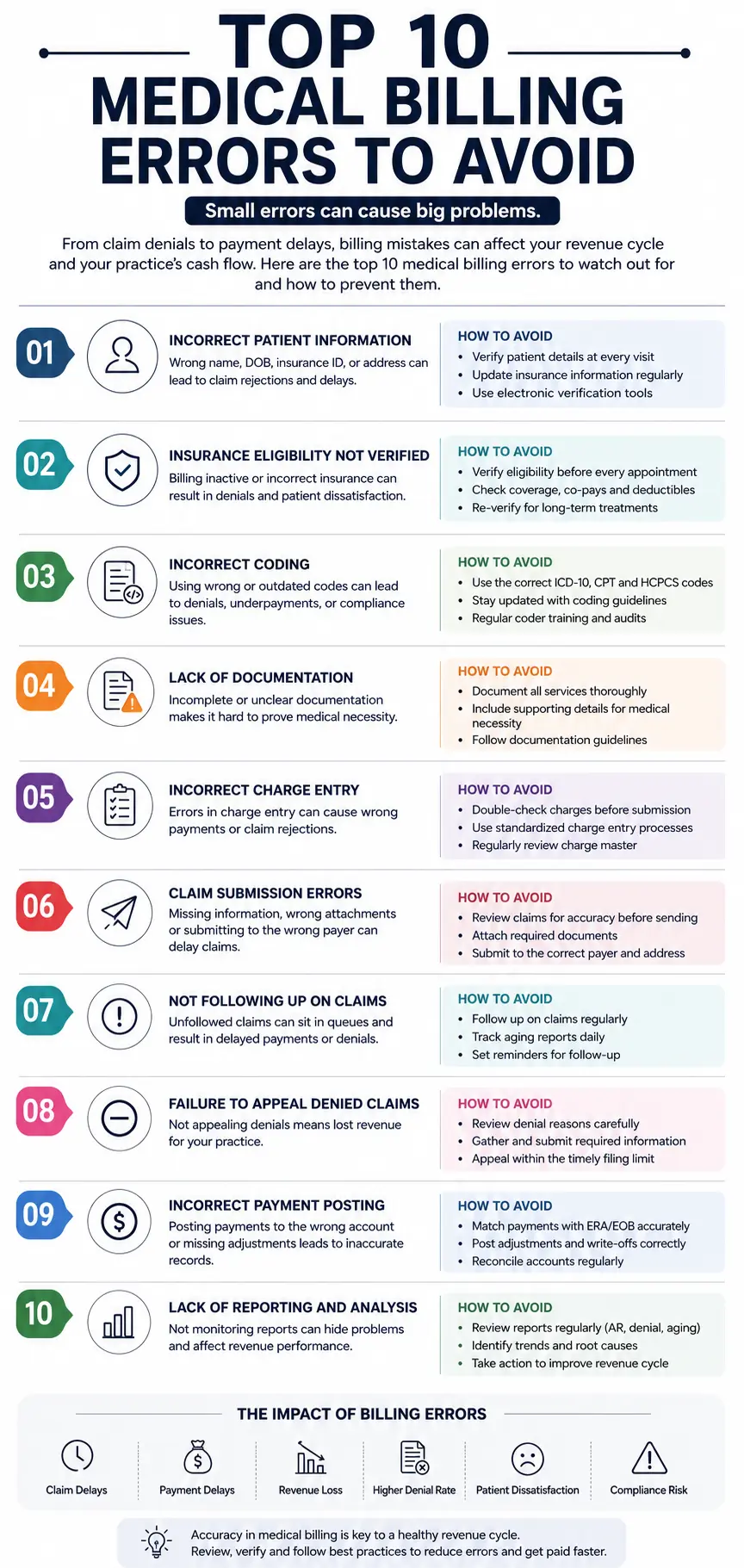
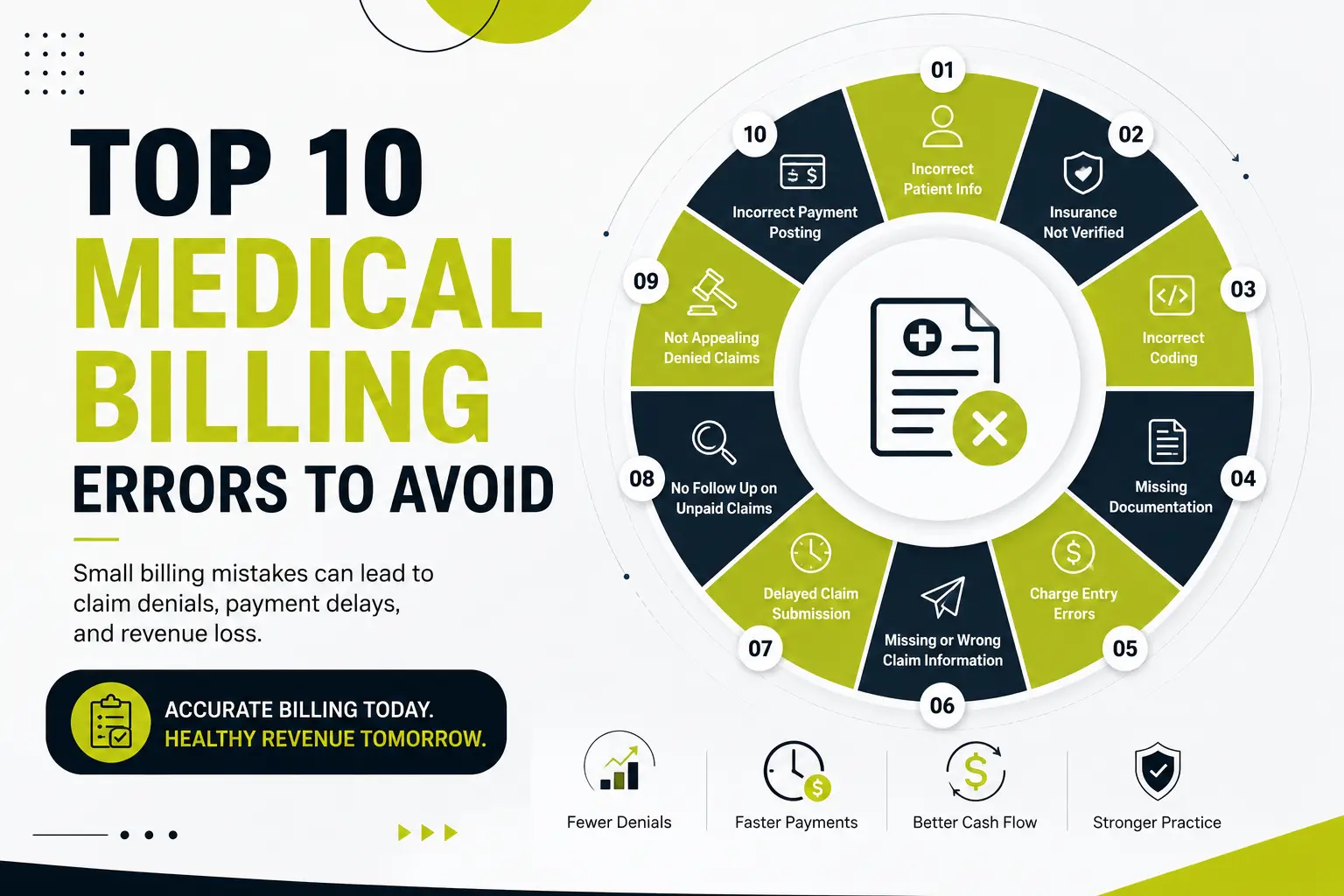
1. Incorrect Patient Information
Wrong names, dates of birth, addresses, or insurance numbers can cause immediate claim rejections.
Staff should confirm patient and insurance details at every visit. Updated information helps claims reach the correct payer without delay.
2. Insurance Eligibility Not Verified
A patient may present an insurance card, but the policy may no longer be active. The service may also require a referral or prior authorization.
Eligibility should be checked before the appointment. Confirm coverage, benefits, deductible, copayment, and authorization requirements.
3. Incorrect Medical Codes
Using the wrong diagnosis, procedure, or modifier code can lead to denials and underpayments.
Coders should use current ICD 10, CPT, and HCPCS codes. Every code should match the service and the provider’s documentation.
4. Incomplete Provider Documentation
Coders cannot select accurate codes when the medical record is incomplete.
Providers should document the reason for the visit, services performed, treatment decisions, and medical necessity. Notes should also be completed and signed on time.
5. Charge Entry Errors
Incorrect units, service dates, charges, or provider details can affect payment.
Billing staff should review charges before claim submission. Comparing schedules, encounter records, and charge reports can also help find missing services.
6. Missing Claim Information
A claim may be rejected because of a missing authorization number, incorrect payer, invalid provider information, or wrong place of service.
Claim scrubbing and manual review can help detect these issues before the claim reaches the payer.
7. Delayed Claim Submission
Claims submitted late may miss payer filing deadlines.
Practices should enter charges and submit claims as soon as documentation and coding are complete. Delayed submission also increases the time it takes to receive payment.
8. No Follow Up on Unpaid Claims
A submitted claim should not be forgotten.
Billing teams should regularly review claim status, payer requests, pending claims, and accounts receivable reports. Early follow up helps prevent claims from becoming too old to collect.
Need Help Avoiding Medical Billing Errors?
Get expert support with accurate coding, clean claim submission, denial follow up, payment posting, and A/R management.
9. Failure to Appeal Denied Claims
Some practices accept denied claims without reviewing the reason.
Many denials can be corrected, resubmitted, or appealed. Staff should review the payer response, documentation, coding, and filing deadline before taking action.
10. Incorrect Payment Posting
Posting a payment or adjustment to the wrong account can create incorrect balances.
Payment posters should match payments with the correct claim and review deductibles, copayments, contractual adjustments, and denial codes carefully.
Medical Billing Error Prevention
Medical billing error prevention starts before the claim is created.
Front desk staff should collect accurate patient information. Providers should complete documentation on time. Coders should use correct codes. Billing staff should review claims, clearinghouse reports, payments, and denials.
Regular staff training and internal audits can also help identify repeated mistakes.
Claim Denial Prevention
Claim denial prevention is easier when practices understand where errors begin.
Many denials start with incorrect registration, missing authorization, incomplete documentation, or coding mistakes. Reviewing these areas before claim submission can reduce rework and improve payment speed.
Practices should also track denial reasons. When the same denial appears repeatedly, the team should fix the source of the problem instead of correcting each claim separately.
Accurate Medical Billing Process
An accurate medical billing process connects every step of the revenue cycle.
It includes patient registration, insurance verification, provider documentation, coding, charge entry, claim submission, payment posting, denial management, and reporting.
Each department should understand its role. Clear communication between front desk staff, providers, coders, and billers helps prevent errors and keeps claims moving.
Reducing medical billing errors can improve claim acceptance, protect revenue, and create a better experience for both staff and patients.
FAQ
What are the most common medical billing errors?
Common errors include incorrect patient details, unverified insurance, wrong codes, missing documentation, charge entry mistakes, delayed submission, and incorrect payment posting.
How do medical billing errors affect a practice?
They can cause claim rejections, denials, payment delays, lost revenue, incorrect patient balances, and extra work for billing staff.
How can medical billing errors be prevented?
Practices can prevent errors by verifying patient information, checking eligibility, using current codes, completing documentation on time, reviewing claims, and following up regularly.
What is the difference between a rejected and denied claim?
A rejected claim usually contains missing or incorrect information and may not enter payer processing. A denied claim is processed but not paid because a payer requirement was not met.
Can denied claims be corrected?
Yes. Depending on the reason, a claim may be corrected, resubmitted, or appealed with supporting information.
How often should clearinghouse reports be reviewed?
Clearinghouse reports should be reviewed daily so rejected claims can be corrected quickly.
Why is accurate documentation important?
Accurate documentation supports coding, medical necessity, and the services billed on the claim.
Can outsourcing reduce medical billing errors?
A professional billing company can help improve coding, claim submission, payment posting, follow up, and denial management.