
Claim denials delay payment, increase staff work, and make revenue less predictable. Many denials begin with small errors that a practice can prevent before the claim reaches the payer. A wrong member number, missing authorization, weak documentation, or incorrect code can turn a normal claim into weeks of follow up.
The Top 10 Ways to Reduce Claim Denials give healthcare practices a clear process for preventing these errors. The goal is not only to correct denied claims faster. The stronger goal is to stop avoidable denials before submission and improve the quality of every claim.
A reliable process connects the front desk, clinical team, coding team, and billing team. Each group controls part of the information that payers review. When these teams share clear rules and check their work at the right time, claims move more smoothly and payments arrive sooner.
Table of Contents
ToggleTop 10 Ways to Reduce Claim Denials at a Glance
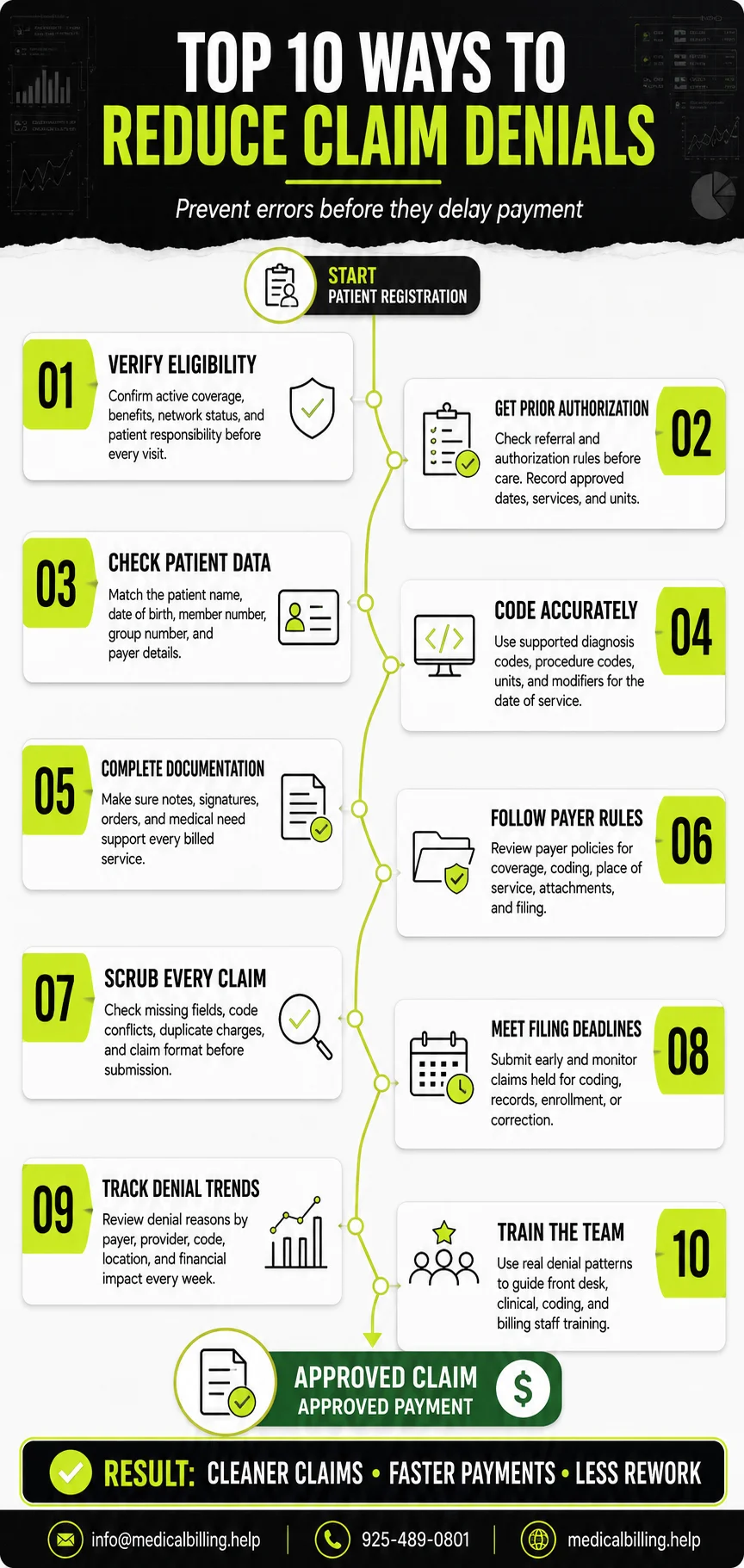
- Verify insurance eligibility
- Confirm prior authorization
- Collect accurate patient data
- Use correct codes and modifiers
- Review complete documentation
- Follow payer billing rules
- Scrub claims before submission
- Meet every filing deadline
- Track denial causes
- Train staff and review results
Why Claim Denials Hurt Practice Revenue
A denied claim does more than delay one payment. Staff must read the payer response, find the cause, collect missing details, correct the claim, and submit it again. This extra work raises the cost of collection and takes attention away from new claims. Some claims never recover because the filing limit expires or the practice lacks the proof needed for an appeal.
Denials also make cash flow difficult to predict. A practice may provide the service today but wait weeks or months for payment. Tracking the causes of denials helps leaders see where revenue is leaking and which process needs attention first.
Medical Claim Denial Prevention Starts Before Care
Medical claim denial prevention starts when the patient schedules an appointment. The practice should collect accurate details, confirm active coverage, review benefits, and identify any referral or authorization rule. Early checks give staff time to solve a problem before the patient receives the service.
A strong front end process should also tell the clinical and billing teams what the payer requires. This shared information supports correct documentation, coding, and claim submission. Medical claim denial prevention becomes easier when every team can see the same verified information before the visit.
1. Verify Insurance Eligibility Before Every Visit
Insurance coverage can change at any time. A patient may switch plans, lose coverage, move to a different network, or receive a new member number. Staff should verify eligibility before each visit instead of relying on information stored from an earlier appointment.
The check should confirm that coverage is active on the date of service. It should also review the plan type, copay, deductible, network status, and limits that affect the planned service. Our insurance eligibility verification services help practices identify these issues before they become denials.
2. Confirm Prior Authorization and Referral Rules
Some services require payer approval before treatment. Other plans require a referral from a primary care provider. A practice should confirm these rules before scheduling the service and record the authorization number, approved dates, approved units, and covered procedure.
Staff should compare the final service with the approval before billing. A change in the procedure, date, location, or number of units may require an update. CMS explains that prior authorization and preclaim review can help providers address coverage issues early and avoid denials and appeals.
3. Collect Accurate Patient and Insurance Information
Simple data errors cause many avoidable rejections and denials. Staff should confirm the patient name, date of birth, address, member number, group number, and payer details. The information on the claim should match the insurance record exactly.
The practice should also confirm the relationship to the subscriber and coordination of benefits when the patient has more than one plan. A short review at check in can prevent days of correction later. Clear registration rules help new and experienced staff follow the same process.
4. Use Correct Diagnosis Codes, Procedure Codes, and Modifiers
The codes on a claim must describe the service and match the medical record. Coders should use the correct code set for the date of service and choose the highest level of detail supported by the documentation. They should never select a more specific code when the record does not support it.
Modifiers also need careful review because they explain special details about a service. An unnecessary, missing, or incorrect modifier can change payer processing. The official CMS National Correct Coding Initiative helps prevent improper payments caused by incorrect code combinations and units. This is the only outbound reference in the post.
Clean Claim Submission Depends on Complete Documentation
Clean claim submission depends on a medical record that clearly supports the billed service. The note should explain why the service was needed, what the provider did, and what result or plan followed. Signatures, dates, orders, test results, and other required details should be present before the coder completes the claim.
Complete records make code selection easier and help the payer understand medical need. They also give the practice stronger support if a payer requests records. Good documentation is a shared responsibility between providers, clinical staff, coders, and the billing team.
5. Review Documentation Before Coding and Billing
A practice should not send a claim when the note is incomplete. The billing workflow should identify unsigned notes, missing orders, unclear diagnoses, and services that lack enough detail. Staff should return the record to the right person while the visit is still fresh.
Simple documentation prompts can improve consistency without making notes longer than needed. The goal is a clear record, not repeated text. Accurate medical coding services depend on documentation that supports every diagnosis, procedure, unit, and modifier reported on the claim.
6. Follow Payer Specific Billing Rules
Payers may apply different rules for coverage, coding, referrals, place of service, attachments, and filing. A claim that one payer accepts may fail with another payer. Billing teams should keep current payer guides and make important rules easy to find during claim review.
The practice should update its workflow when a payer changes a policy or claim edit. Staff should record the effective date and identify which services, providers, or locations are affected. Regular payer updates prevent teams from repeating an old process that no longer works.
7. Scrub Every Claim Before Submission
A claim scrubber can check for missing fields, invalid code combinations, incorrect patient details, duplicate charges, and other common errors. These checks allow staff to correct a claim before the clearinghouse or payer rejects it.
Technology works best when the team reviews its rules and results. If staff ignore warnings or use old edits, the tool will not protect revenue. Clean claim submission should combine automated checks with human review for unusual services, payer rules, and documentation concerns.
Denial Management Strategies Need Clear Ownership
Effective denial management strategies assign every denial to a person or team, set a response date, and record the final outcome. Without clear ownership, denied claims may sit in a work queue until the payer deadline passes. A defined process keeps each account moving.
The team should separate denials by cause, payer, provider, location, and service. This view turns individual problems into useful patterns. Our denial management services focus on both recovery and prevention so the same issue does not continue reducing revenue.
8. Submit Claims Before Filing Deadlines
Every payer sets a time limit for initial claims and corrected claims. Practices should not wait until the final days to submit. Early submission leaves time to fix a rejection, collect a missing record, or correct enrollment details before the deadline.
A daily claim release schedule helps prevent backlogs. Staff should also monitor claims held for coding, documentation, or provider review. The team needs alerts for accounts that are getting close to a filing limit so urgent work receives attention first.
9. Track Denial Reasons and Fix Repeating Patterns
A denial report should show more than the total number of denied claims. It should identify the reason, payer, code, provider, location, dollar value, and team responsible for the original step. This detail helps leaders focus on the problems with the greatest financial effect.
The team should review the report every week and compare results over time. When one payer repeatedly denies the same code, staff can check the policy and update the claim rule. When one location has frequent eligibility denials, the practice can improve registration training. These denial management strategies turn reports into action.
10. Train Staff and Review Performance Regularly
Staff need training that matches their role. Front desk teams should understand eligibility and patient data. Clinical teams should know documentation needs. Coders should receive code updates. Billers should understand payer edits, filing limits, correction rules, and appeal steps.
Training should continue after a new employee starts. Short reviews based on real denial patterns are often more useful than general lessons. Leaders should share results without blaming people. The purpose is to improve the process and help the whole team prevent the next denial.
How to Improve First Pass Claim Rate Across Teams
To improve first pass claim rate, a practice needs one connected workflow from scheduling to payment. The front desk verifies coverage, the provider documents the service, the coder selects supported codes, and the biller completes final checks. Each team should know what information the next team needs.
Practices should measure the percentage of claims accepted on the first submission and review why the remaining claims failed. Teams improve first pass claim rate when they use that information to correct repeat errors. A rising rate often means fewer corrections, faster payment, and less staff work. Our guide on improving first pass claim acceptance explains this measure in more detail.
What to Do When a Claim Is Denied
Start by reading the remittance advice and payer message carefully. Confirm whether the claim was rejected before processing or denied after review. Then compare the reason with the claim, medical record, eligibility result, authorization, and payer policy.
Correct the claim only when correction is the right action. Some denials require an appeal with records or proof. Others require a corrected claim, a payer call, or a patient coverage update. Record what the team did and follow the claim until the payer issues a final decision.
How Medical Billing Help Supports Cleaner Claims
Medical Billing Help reviews the complete revenue cycle instead of treating every denial as a separate event. Our team can support eligibility checks, coding, claim review, denial follow up, payment posting, and reporting. This connected view helps identify where claim errors begin.
Practices that need wider support can explore our revenue cycle management services. A clear workflow can reduce medical claim denials, improve payment speed, and give staff more time to support patients.
A Better Claim Process Starts Today
The Top 10 Ways to Reduce Claim Denials work best when a practice applies them every day. Verify coverage, confirm authorization, collect accurate data, code from complete documentation, follow payer rules, scrub claims, meet deadlines, study denials, and train the team.
Begin with the denial category that costs the most time or money. Fix the process, measure the result, and then move to the next problem. Small improvements across the full claim cycle can create cleaner submissions, faster payments, and a more stable revenue cycle.
Need Help With Reducing Claim Denials?
Our billing specialists can review claim workflows, find denial patterns, and help your practice submit cleaner claims with less rework.
FAQs
What are the most common reasons medical claims are denied?
Common causes include inactive coverage, incorrect patient details, missing authorization, coding errors, incomplete documentation, duplicate claims, payer rule conflicts, and missed filing deadlines.
How can a medical practice reduce claim denials?
A practice can reduce denials by checking eligibility, confirming authorization, improving documentation, using accurate codes, scrubbing claims, meeting deadlines, and reviewing denial reports every week.
What is a clean claim?
A clean claim contains complete and accurate information, follows the payer format and rules, and does not need extra correction before the payer can process it.
How often should a practice review denial reports?
Most practices should review denial reports every week. A monthly leadership review can then compare trends, financial impact, payer performance, and progress on corrective actions.
Can a medical billing company help prevent denials?
Yes. A skilled billing company can support eligibility, coding, claim review, payer follow up, denial analysis, and reporting. It should also show the practice where repeat errors begin.